Best MetaTrader 5 (MT5) Brokers For Swing Trading 2026

Contributor Image
Written By
Contributor Image
Written By
Christian Harris
Christian is an experienced swing trader with years actively trading stocks, futures, forex, and cryptocurrencies. He focuses on short- to medium-term strategies, combining technical analysis with disciplined risk management. His real-world trading experience helps him provide valuable perspectives for aspiring swing traders.
Contributor Image
Edited By
Contributor Image
Edited By
James Barra
James is an investment writer with a strong focus on evaluating swing trading platforms. Drawing on his background in financial services, he brings a clear, analytical perspective. He researches, writes, edits, and fact-checks content across several online trading websites, with an emphasis on broker reviews and educational resources designed for swing traders.
Contributor Image
Fact Checked By
Contributor Image
Fact Checked By
Tobias Robinson
Tobias brings over 25 years of hands-on trading experience across stocks, futures, commodities, bonds, and options. He leads the testing team at SwingTrading.com, focusing on broker reviews and trading tools tailored to the needs of active swing traders.
Updated

Swing traders hold trades for a few days, maybe weeks, aiming to catch bigger price moves. That’s why the tools and setup you use in MetaTrader 5 (MT5) matter, and that’s also why you need a broker that offers excellent integration with MT5.

Fortunately, we’ve selected the best broker for swing trading on MT5 – all tested by experienced MetaQuotes users.

How SwingTrading.com Chose The Top MT5 Brokers

We chose the best MT5 brokers by ranking supporting brokers based on their overall ratings, focusing on features that matter most to MetaTrader 5 users, from multi-asset access and execution speed to support for Expert Advisors, custom indicators, and advanced charting.

Our team’s hands-on testing added a practical layer, helping us separate brokers that simply provide MT5 access from those that deliver a seamless, high-performance MT5 swing trading experience.

Why MT5 For Swing Trading

MT5 is built with more features than its older cousin, MT4. For swing trading, some of these stand out:

  • More timeframes: You get 21 instead of MT4’s 9, which helps when analyzing daily and weekly trends.
  • Economic calendar: Handy when you want to track events that could drive longer-term moves.
  • Better order management: You can place more types of pending orders, which gives you flexibility when planning trades.

So if you trade swings, MT5 gives you more structure to plan and manage trades over several days.

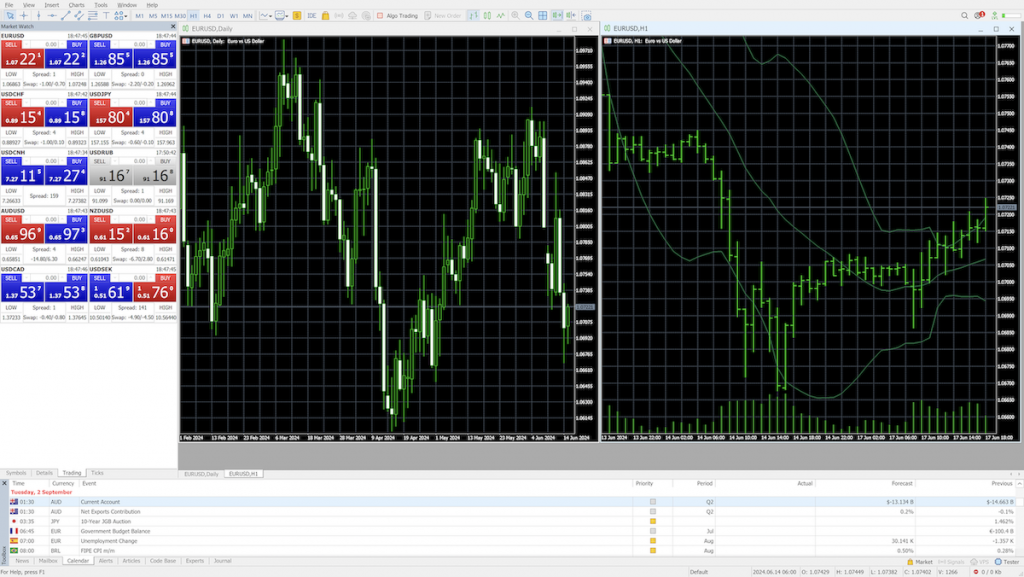
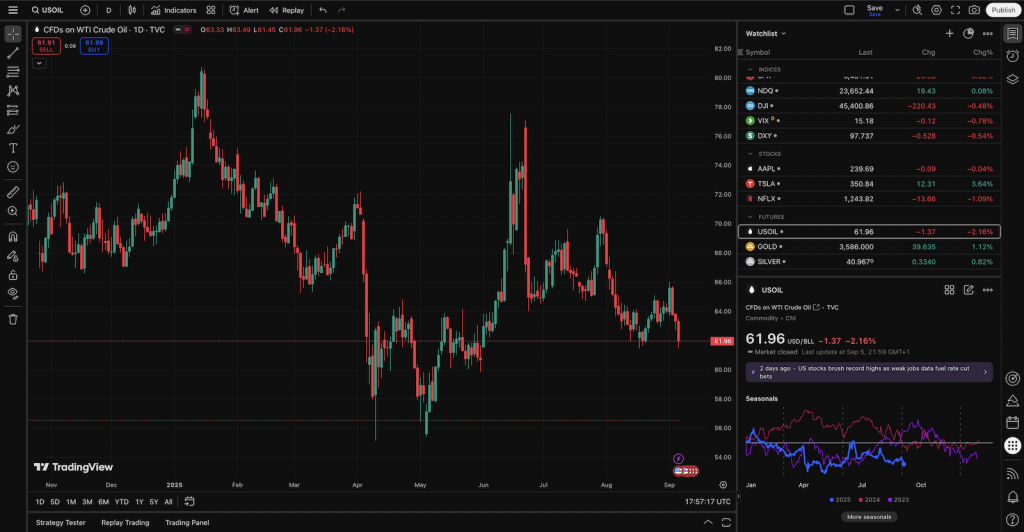
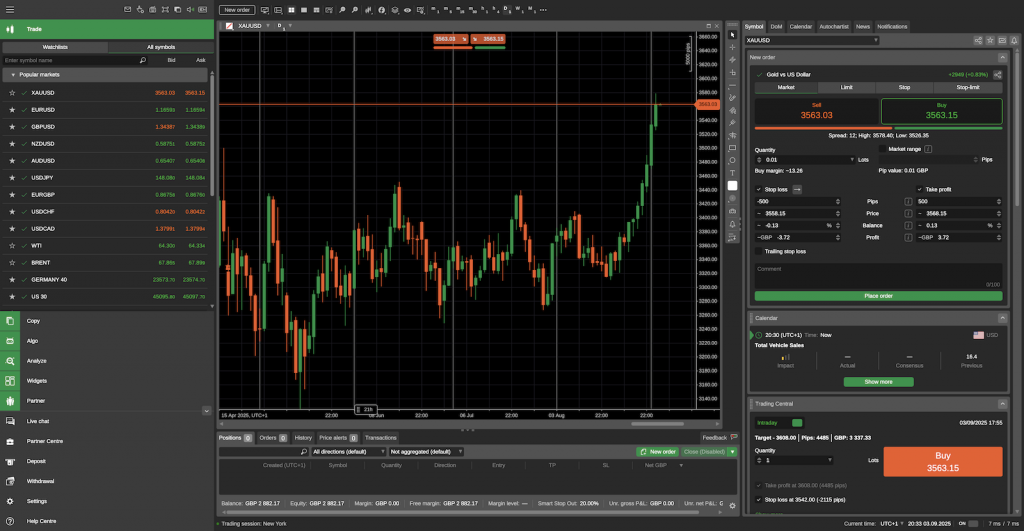
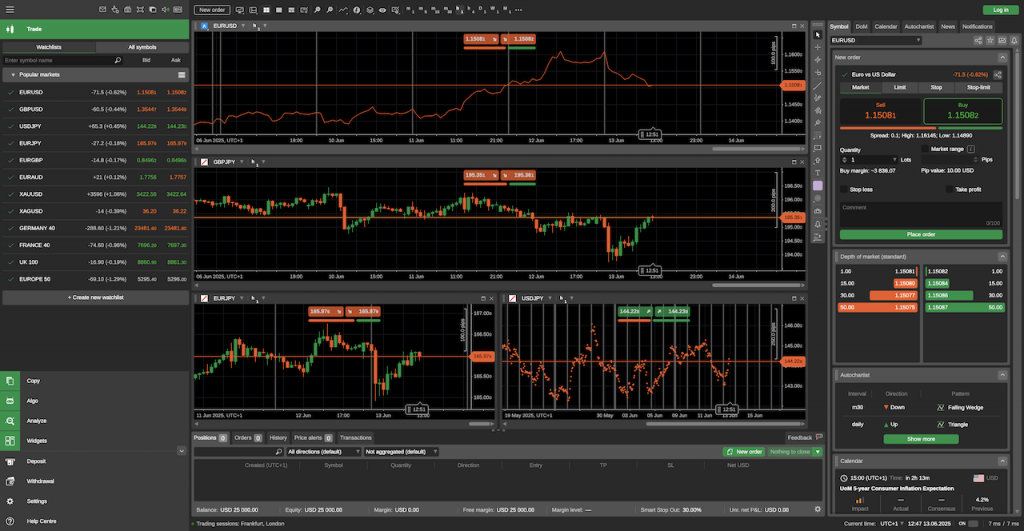
Swing trading on an MT5 chart

MT5’s timeframes and order types help manage trades that last several days

What To Look For In An MT5 Broker

Charting Tools That Matter

Charts are your primary workspace. Swing traders need to zoom out and see the bigger picture. On MT5, look for a broker setup that:

  • Supports daily and weekly chart views without lag.
  • Lets you apply multiple indicators without slowing down.
  • Allows drawing tools like trendlines and Fibonacci retracements, which are key for spotting entry and exit zones.

A good MT5 setup makes analysis smoother and saves you time.

When I switched to MT5, the most significant difference wasn’t the extra indicators—it was how easy it became to track trades across daily and weekly charts.

The platform isn’t perfect, but having clearer timeframes and reliable order handling has saved me from second-guessing entries and exits.

author image
Christian Harris
Author

Data Reliability & Pricing

Price accuracy is critical. Swing traders often hold trades across volatile news events. Delays or bad price feeds can ruin a position. Check if the broker’s MT5 platform gives you:

  • Consistent pricing without significant gaps between bid and ask.
  • Low slippage, especially during high-volume hours.
  • Clear swap rates (overnight funding costs), since you’ll likely pay or earn swaps when holding trades for days.

It’s not about finding the lowest spread at all times. For swing traders, stable and honest pricing matters more.

Order Execution

Execution speed isn’t as urgent as it is for scalpers, but it still counts. When you place a stop or limit order, you want it filled close to the price you set. Look for:

  • Reliable order fills without frequent re-quotes.
  • Smooth execution during news events, since that’s when swings often take shape.
  • Access to stop-limit orders, which give you better control of entries.

MT5 supports multiple order types. The broker should make sure they work as intended.

Swap & Overnight Costs

One of the most significant differences between day trading and swing trading is the use of swaps.

When you hold positions overnight, you either pay or receive swap fees. They can add up over weeks. On MT5, a broker should:

  • Display swap rates clearly in the contract specs.
  • Update swap values regularly so you aren’t caught off guard.
  • Allow you to calculate potential costs directly from the platform before entering trades.

This matters more than spreads for swing traders. Even a good setup can fail if costs eat into your gains.

Holding trades overnight on MT5 taught me quickly that swap costs matter more than spreads. I’ve had setups play out exactly as planned, only to see profits trimmed by funding charges. Now I always check the swap info in MT5 before committing to a swing.
author image
Christian Harris
Author

Hedging & Risk Tools

Swing traders often hedge positions or hold multiple trades across pairs. MT5 supports hedging, but brokers can enable or restrict it. Make sure you get:

  • Permission to hedge positions on the same instrument.
  • Margin rules that won’t wipe out your account if you hold several trades at once.
  • Access to risk management tools like stop-loss and trailing stops that actually trigger when they should.

For swing trading, risk control is everything. The broker’s MT5 system should not block or limit these features.

Market Access

Swing trading often works best with liquid markets—forex, indices, commodities. MT5 brokers differ in what they offer. Check if:

  • You have access to enough instruments to diversify swings.
  • The broker provides CFDs on indices and commodities, as these often exhibit clean trends for extended periods.
  • Data feeds for these markets are reliable on daily and weekly charts.

It’s not about having hundreds of instruments. It’s about having a clean, usable set for swing trading.

Account Types That Fit Swing Trading

Not every account type on MT5 is suitable for swing traders. For example:

  • Ultra-low spread accounts may come with higher swaps.
  • Commission-based accounts make more sense if you hold trades for a week.
  • Some accounts may offer higher leverage, which isn’t always needed for swings but can help with flexibility.

Read the account specs carefully. The way fees are structured will affect how much you keep from longer-term trades.

Mobile & Web Access

Swing traders don’t need to watch the screen all day, but they still need to check trades on the go. MT5 has mobile and web versions. The broker should:

  • Offer stable mobile trading apps with the same charting tools.
  • Sync orders across devices without errors.
  • Allow you to adjust stops or close trades easily from your phone.

This way, you can manage swings without sitting at your desk 24/7.

Using MT5 on my phone has been a lifesaver for swing trades. I don’t need to babysit charts all day, but being able to move a stop or close a position while I’m away from my desk has kept me out of trouble more than once.
author image
Christian Harris
Author

Support For Strategy Testing

Before running a swing system, you should test it. MT5 has a built-in strategy tester. A broker should allow:

  • Full access to historical data across daily and weekly charts.
  • Smooth testing without platform crashes.
  • Accurate spreads and swaps in backtesting.

Testing is essential for swing traders, since trades play out over longer cycles.

Stability Of The Platform

Swing trades don’t need lightning-fast charts, but you do need a stable platform. Look for:

  • MT5 setups that don’t freeze during market opens.
  • Reliable server uptime, since your trades may run for weeks.
  • Quick reconnections if your internet drops.

If MT5 disconnects during a swing, you could lose control of your trades. Stability is as important as execution speed.

Final Thoughts

The best MT5 broker for swing trading is one that maintains steady and predictable trade execution over time, without unexpected costs or platform performance issues.

It’s less about flashy features and more about reliability, transparency, and a platform setup that matches the way swing traders actually work.

Best MetaTrader 4 (MT4) Brokers For Swing Trading 2026

Contributor Image
Written By
Contributor Image
Written By
Christian Harris
Christian is an experienced swing trader with years actively trading stocks, futures, forex, and cryptocurrencies. He focuses on short- to medium-term strategies, combining technical analysis with disciplined risk management. His real-world trading experience helps him provide valuable perspectives for aspiring swing traders.
Contributor Image
Fact Checked By
Contributor Image
Fact Checked By
Tobias Robinson
Tobias brings over 25 years of hands-on trading experience across stocks, futures, commodities, bonds, and options. He leads the testing team at SwingTrading.com, focusing on broker reviews and trading tools tailored to the needs of active swing traders.
Updated

With MetaTrader 4 (MT4) still reigning as the go-to platform for forex and CFD traders worldwide, choosing the right broker can make or break your trading experience.

In this guide, we cut through the noise and spotlight the top swing trading MT4 brokers that combine reliability, low costs, and powerful trading tools.

How SwingTrading.com Chose The Best MT4 Brokers

We log into every broker we review to verify MT4 platform access and assess the trading experience firsthand. Only brokers offering full MT4 support were shortlisted.

We then ranked them based on overall ratings, considering factors like execution speed, fees, tools, and reliability – criteria that matter to serious swing traders.

What Is MetaTrader 4?

MT4 is a longstanding, broker-independent trading platform developed by MetaQuotes, primarily tailored for forex and CFD trading.

Launched in 2005, it has remained a staple for swing traders due to its robust technical analysis capabilities, algorithmic trading support, and highly customizable interface.

While newer platforms like MT5, cTrader, and TradingView have emerged, MT4’s simplicity, speed, and vast ecosystem of tools keep it relevant, especially if you prioritize strategy over novelty.

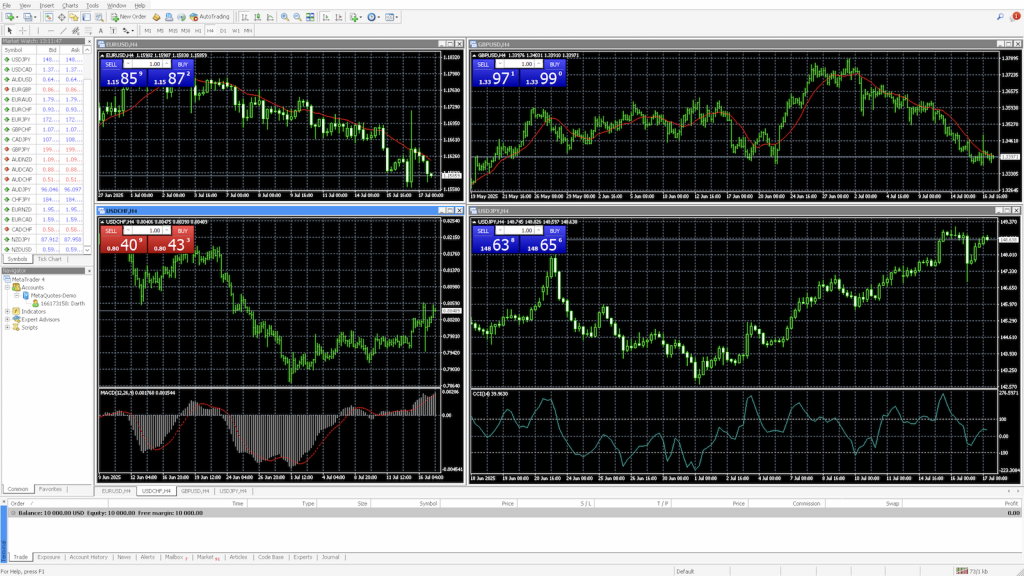
MT4’s interface combines customizable charts and built-in tools

Why Is MetaTrader 4 So Popular?

MT4’s popularity among swing traders—and the brokers that cater to them—comes down to a rare combination of technical power, flexibility, and market access.

At its core, MT4 provides a streamlined environment for multi-timeframe analysis, which is crucial for implementing swing trading strategies. You can easily switch between daily, 4-hour, and weekly charts to spot broader market trends and fine-tune entry points.

Its built-in indicator library, coupled with the ability to add custom scripts and tools, makes it adaptable to virtually any swing trading method, whether momentum-based, trend-following, or mean-reversion.

💡
MT4 remains the industry standard due to its massive ecosystem. Thousands of custom indicators, Expert Advisors (EAs), and trading scripts are available through the MetaTrader marketplace and third-party developers.

This is a significant advantage for swing traders, who often rely on backtested, rule-based systems to minimize emotional decision-making. The platform also supports automated strategy deployment and alerts, allowing you to monitor fewer charts while maintaining control over multi-day positions.

From a broker’s perspective, MT4 is lightweight, stable, and easy to integrate with backend systems, allowing them to offer it with tight spreads, fast execution, and value-added services like VPS hosting or custom plugins.

How To Choose A Top MT4 Broker

Choosing the best swing trading MT4 broker isn’t just about low spreads—it’s about finding the right mix of regulation, execution speed, trading conditions, and platform features that align with your swing trading strategy:

Regulation & Licensing

When selecting the best MT4 broker, regulation and licensing should be top priorities. Trusted financial regulators, such as the FCA (UK), ASIC (Australia), and CySEC (Cyprus), enforce strict standards regarding client fund protection, operational transparency, and financial reporting.

These regulators require brokers to hold client funds in segregated accounts, maintain minimum capital reserves, and undergo regular audits.

Since swing trading involves holding trades over more extended periods than day trading, the risk of exposure to market events, broker insolvency, or price manipulation increases.

💡
A licensed broker under a Tier-1 or Tier-2 regulator reduces the chance of slippage manipulation, delayed withdrawals, or unfavorable margin call practices—issues more common with unregulated offshore brokers.

Another key benefit of choosing a regulated MT4 broker is access to dispute resolution mechanisms. Regulators like the FCA or ASIC provide formal avenues for lodging complaints if you feel you’ve been mistreated.

This kind of protection is especially valuable in cases involving platform errors, execution issues, or sudden account restrictions—all of which can impact swing traders who rely on precise trade management over time.

Platforms & Devices

MT4 supports a wide range of platforms, giving you the flexibility to manage positions across multiple devices and environments.

The core platform is available for desktop operating systems, including Windows, macOS, and Linux, providing full access to MT4’s advanced charting tools, custom indicators, automated trading via EAs, and comprehensive backtesting capabilities.

💡
For swing traders who rely on technical analysis and multi-timeframe setups, the desktop version remains the most powerful and feature-rich option.

MT4 also offers robust mobile support for iOS, Android, and Huawei devices, enabling you to monitor open positions, set alerts, and manage trades remotely from your primary workstation.

While mobile versions are more streamlined and lack advanced features like EAs or custom scripting, they’re invaluable when you need quick access to markets during unexpected price movements or overnight developments.

Additionally, MT4 features a web-based terminal that operates seamlessly in most modern browsers, eliminating the need for installation. Although more limited than the desktop version, it still supports order execution, basic charting, and indicator use, making it a convenient option for secure access from different locations or machines.

Many top MT4 brokers also offer VPS hosting, which is especially useful when running automated strategies that require uninterrupted uptime. This ensures that EAs can execute trades and manage positions even when your device is offline.

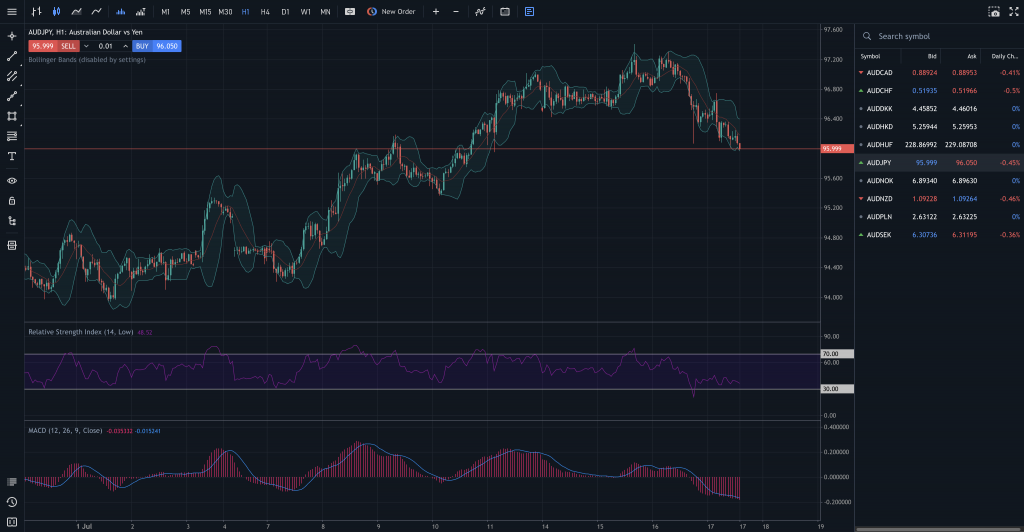
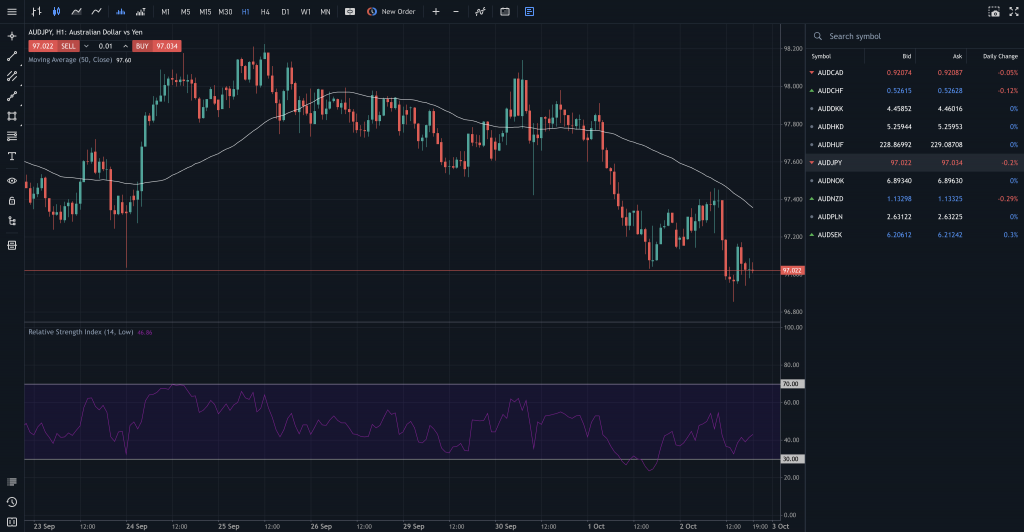
Trading AUDJPY on MT4 Webtrader

MT4 Web Trader provides a clean, browser-based platform with essential tools

Account Types

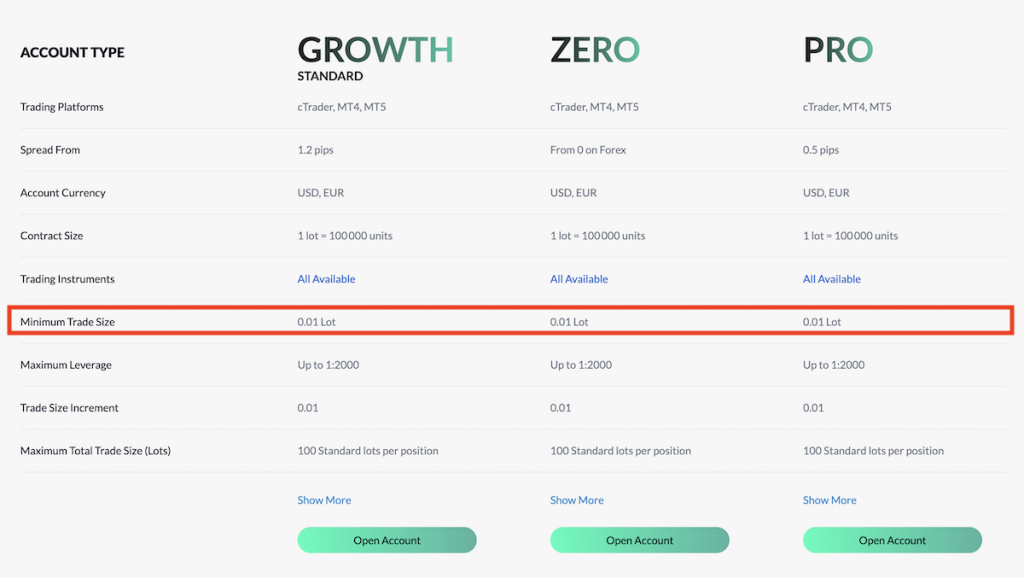
The most common account types are Standard, Raw (ECN), and Micro, each of which impacts costs and trading style differently.

Standard accounts offer fixed or variable spreads with no commissions, making them cost-effective and straightforward for beginners, though spreads may be wider.

Raw (ECN) accounts offer tighter spreads (sometimes zero) and commissions, making them ideal for experienced swing traders seeking lower costs and faster execution around key market levels. These accounts often require higher deposits but deliver better pricing and transparency.

Micro accounts enable tiny trades, making them ideal for testing strategies with minimal risk. They typically have higher spreads but offer a safe way for newcomers to practice swing trading on MT4.

The best MT4 brokers offer flexible account options to match your capital, strategy, and cost preferences, enabling you to trade efficiently and confidently over the longer timeframes that swing trading demands.

In my experience, starting with a standard account was great for getting comfortable with swing trading, but switching to a ECN account made a noticeable difference in long-term cost efficiency—especially when holding larger positions over several days.
author image
Christian Harris
Author

Execution Speed & Reliability

While swing trading doesn’t rely on split-second execution like scalping does, the speed and consistency of trade execution still directly affect entry and exit precision, key elements for capturing multi-day trend movements with minimal slippage.

STP and ECN brokers typically offer faster and more transparent order execution by routing trades directly to liquidity providers without the need for dealing desk intervention.

This reduces the chance of requotes and improves the accuracy of stop-loss and take-profit orders, which are critical for swing traders who often hold trades through volatile sessions, such as market openings or major news events.

ECN brokers, in particular, provide access to raw spreads and deep liquidity, making them ideal if you value tight pricing and fast execution even during off-peak hours.

On the other hand, Market Maker brokers operate as counterparties to their clients’ trades, which can introduce potential conflicts of interest.

While they may offer fixed spreads and better trade execution in low-volatility environments, there’s a higher risk of slippage, requotes, or order delays—especially during high-impact news or periods of low liquidity.

For swing traders whose strategies depend on entering at technically significant levels and exiting with precision, this lack of reliability can erode profitability over time.

Trading Costs

Understanding trading costs—such as spreads, commissions, and swap fees—will significantly impact your long-term profitability.

Spreads are the difference between bid and ask prices—tighter spreads reduce entry and exit costs. ECN accounts offer low spreads plus commissions, while standard accounts have wider spreads but no commissions, so the choice depends on your trade size and frequency.

Commissions on ECN accounts add to costs but often result in lower overall expenses for larger trades or volatile markets.

Meanwhile, swap (rollover) fees matter most for swing traders holding positions overnight, as these interest charges can either add costs or generate credits depending on the trade and currency pair. Some brokers offer swap-free accounts, but these often come with trade-offs.

The best MT4 brokers balance these fees transparently, helping you keep costs manageable over multi-day trades and protect profits.

Deposit & Withdrawal Options

Deposit and withdrawal options are key to smooth account management. Brokers offering multiple funding methods—such as bank transfers, credit/debit cards, and e-wallets like Skrill or Neteller—provide you with flexibility and quick access to funds, which is essential for adjusting capital or taking profits between trades.

Fees and processing times also vary significantly between brokers and payment methods. While some brokers absorb deposit fees, others may charge commissions or currency conversion fees, which can add up over time.

Similarly, withdrawal fees and delays can be frustrating when you rely on timely access to your funds. Brokers regulated by authorities such as the FCA or ASIC typically maintain transparent fee structures and fast processing times, providing you with peace of mind.

Minimum deposit requirements matter too. Reasonable minimums enable you to manage risk effectively without tying up excessive capital. Features such as instant deposits and same-day withdrawals also allow you to react quickly to market changes.

From my own experience, having flexible deposit and withdrawal options has been a significant advantage, especially when I’ve needed to transfer funds quickly between trades. I rely on fast withdrawals after closing swing positions, and brokers that offer smooth, hassle-free processing have earned my trust.
author image
Christian Harris
Author

Leverage & Margin Requirements

Leverage allows you to control larger positions with less capital—helpful in capturing multi-day price moves—but excessive leverage can magnify losses during market swings.

Top brokers offer adjustable leverage, allowing you to tailor your risk. Regulated brokers (such as those under the FCA or ASIC) may cap leverage at 1:30, but often offer higher limits for professional accounts.

Margin requirements also matter—sufficient free margin helps prevent forced liquidations during volatile periods.

The best MT4 brokers strike a balance by offering flexible leverage and clear margin rules, along with protections such as negative balance protection and margin alerts, which give you both opportunity and control.

Market Coverage

The best brokers offer a wide range of instruments, including forex pairs, commodities, indices, stocks, and CFDs, enabling you to diversify and find high-quality setups across various markets.

Beyond major forex pairs, access to minors, exotics, and global indices, such as the S&P 500 or DAX, adds flexibility.

Commodities such as gold and oil are also popular due to their strong trends, making them ideal for multi-day trades. Some brokers even offer crypto and stock CFDs, expanding swing trading opportunities.

What matters most isn’t just the number of assets, but the liquidity, pricing transparency, and trading hours. The top MT4 brokers combine broad market access with reliable execution, giving you the tools to capture longer-term moves across global markets.

Trading Tools & Add-Ons

While MT4’s core features are solid, the best brokers enhance the platform with tools like Autochartist, Trading Central, or custom plugins, helping you spot high-probability setups and manage multi-day positions more efficiently.

Autochartist scans charts for patterns and key levels across timeframes, saving time and highlighting strategic opportunities. Trading Central combines technical and fundamental analysis to provide clear entry and exit signals, ideal for swing trading.

Proprietary add-ons often include advanced order types, sentiment indicators, and multi-chart views, which are tailored to longer-term trading.

The best MT4 brokers go beyond basic access, offering integrated tools that sharpen analysis, improve trade management, and support disciplined swing strategies—key advantages for sustained trading success.

Having used MT4 across various brokers, I’ve found that many top-tier ones often enhance the platform with advanced charting tools, custom order types, and built-in market scanners—features that make a real difference for swing trading.
author image
Christian Harris
Author

Learning Resources & Market Analysis

Swing trading requires a deeper understanding of technical patterns, market cycles, and fundamental drivers, so brokers that offer comprehensive educational materials—like video tutorials and detailed strategy guides—can help you build the skills needed to identify and manage multi-day trades effectively.

Top brokers also provide regular market analysis tailored to swing trading timeframes, including technical reports, economic calendars, and expert commentary.

These insights enable you to anticipate key market events and adjust your strategies accordingly. Access to live webinars or analyst Q&As can further deepen understanding by connecting you with professional perspectives on market trends.

Additionally, brokers that integrate real-time news feeds and advanced charting tools within MT4 allow you to stay updated and react quickly to changing conditions.

No-Risk Demo Account

A demo trading account allows you to practice strategies and familiarize yourself with the broker’s execution, MT4 platform features, and order types without risking real capital.

For swing traders, testing how a broker handles order execution, slippage, and rollover fees in a simulated environment can reveal crucial insights before committing funds.

Demo accounts also provide a risk-free space to explore different account types, leverage settings, and trading tools offered by the broker.

Since swing trading depends heavily on precise entry and exit points, using a demo helps refine timing and risk management under ‘realistic’ market conditions.

Furthermore, brokers with demo accounts that mirror live trading environments—including spreads, margin requirements, and trade execution speeds—offer the most reliable practice experience.

Help & Support

Brokers offering responsive, knowledgeable support—available via live chat, phone, and email—help ensure that technical or trading disruptions don’t negatively impact your strategy.

Effective support teams understand the specifics of MT4, including advanced order types, custom indicators, and trade management features critical for swing trading.

Brokers that provide dedicated account managers or specialized support for experienced traders can offer tailored guidance, helping you optimize platform settings or troubleshoot complex issues quickly.

Additionally, brokers with extensive online help centers, FAQs, and tutorials complement direct support by enabling you to resolve common problems independently.

I’ve had moments where account or platform questions came up while holding swing trades, and solid support made all the difference. It’s reassuring when a broker’s team responds quickly and actually understands the technical side of MT4—not just reading from a script.
author image
Christian Harris
Author

Bottom Line

To select the best swing trading MT4 broker, look for a combination of regulation, low trading costs, and reliable execution that aligns with your swing trading style.

Choose a broker with multiple account types, flexible leverage options, and access to a broad range of markets and instruments.

Prioritize firms that offer strong trading tools, insightful market analysis, and responsive customer support. A risk-free demo account is also essential for testing strategies before going live.

The right MT4 broker should not only meet your technical needs but also provide a stable, transparent, and well-supported trading environment.

FAQ

Should I Use MT4 Or MT5?

MT4 is ideal for swing traders who value simplicity, speed, and access to a wide range of custom indicators and EAs. It’s widely supported and easy to use.

MT5 offers more features—such as additional timeframes and deeper market access—but isn’t fully compatible with MT4 tools. If you rely on established MT4 setups, it’s best to stick with them. Otherwise, MT5 is worth considering for broader functionality.

Can I Use MT4 & MT5 Accounts Simultaneously?

Yes, you can use MT4 and MT5 accounts simultaneously, but they operate on separate platforms and aren’t interchangeable.

You’ll need to download each platform individually and open separate trading accounts with a broker that supports both.

While you can’t use the same login for both, you can run them side by side to take advantage of each platform’s unique features. Just be aware that indicators and EAs built for MT4 won’t work on MT5, and vice versa.

Plus500

Edited By
Edited By
Updated

Plus500 is an established CFD broker that operates in over 50 countries. The market maker is particularly popular with swing traders and other short-term strategists. This Plus500 review will explore the assets, platforms and live accounts on offer, before outlining the key pros and cons of signing up.

What Is Plus500?

Company Details

You might recognise Plus500 as the sponsor of the Spanish football team Atlético de Madrid (Atletico Madrid). The broker’s logo is displayed prominently on the team’s jersey. The firm is also the main sponsor of the Swiss team BSC Young Boys (YB). Moreover, the company offers a range of CFD products and provides news, market insights and share forecasts. Over 500,000 users are currently active on multiple continents.

History

Plus500 was founded in 2008 and is the biggest CFD broker in the UK, Germany and Spain. As of December 2021, the company had a market capitalisation of $1.69 billion and a net worth of over $500 million. The broker has its headquarters in Israel, plus several global offices in Britain, Europe and Australia.

The brokerage is a publicly-traded company (PLC) and, since 2018, has been listed on the London Stock Exchange (LSE). Going under the ticker PLUS, Plus500 Ltd.’s share price can be found online or through the live share chat on sites such as ADVFN for up-to-date prices and quotes.

If you decide Plus500 stock is a good buy and wish to invest in the company, you may be entitled to dividend payments. Important information regarding investing in the group such as investor relations, presentations, annual and quarterly earnings reports, dividend yield amounts, ex-dividend and dividend payment dates can all be found easily on the firm’s main website.

Trading Platforms

Plus500 offers its own trading platform, which is available as a web trader. The platform is available in 32 languages, including English, German, Greek, Italian, Spanish, French, Finnish, Danish, Swedish, Estonian, Russian, Romanian, Hebrew, Arabic and both Traditional and Simplified Chinese.

Unlike other popular brokers, there is no option to use MetaTrader 4 (MT4), MetaTrader 5 (MT5), cTrader or other similar platforms. Nor is there a downloadable desktop platform for Mac (OS X or otherwise) or Windows 7/8/9 or 10.

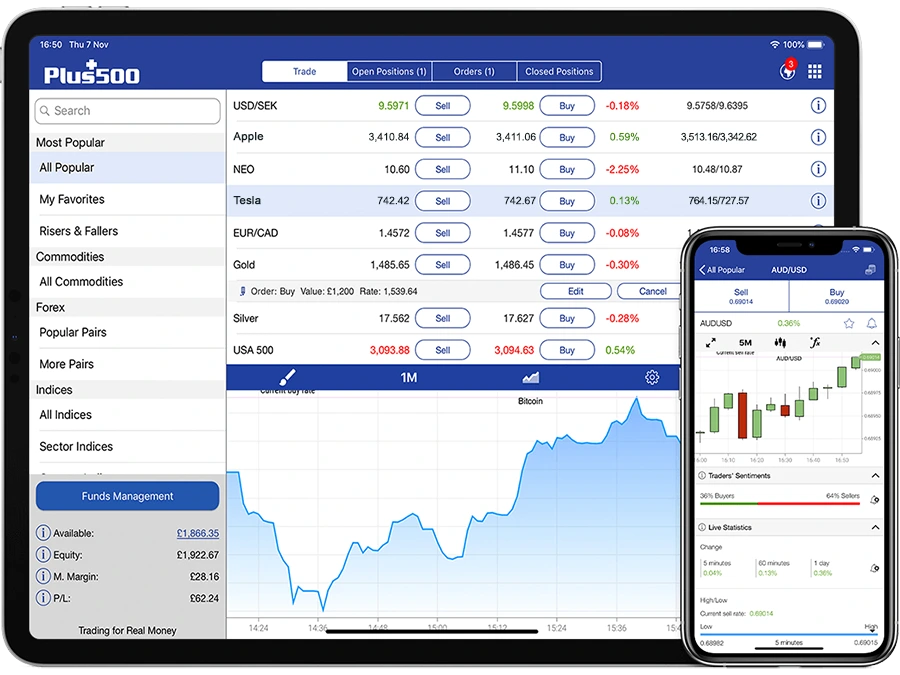
Plus500 derivatives trading software and technical indicators

WebTrader

Still, the platform is user-friendly and easy to get to grips with, though the interface is non-customisable and there is no API available for algorithmic trading using programming languages such as Python. Traders used to platforms such as MT4 will likely see this as a downside. However, many users find the platform fully functional. The platform does not support copy trading.

Mobile App

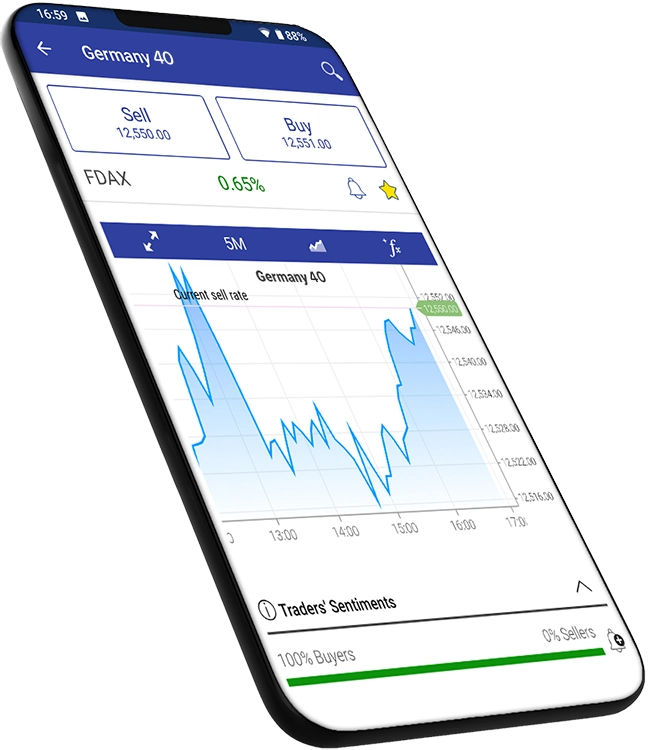
The Plus500 mobile app is available to download for Android and iOS devices from the Google Play Store or the App Store. The application is much like the WebTrader platform, containing the same features arranged in a straightforward and intuitive layout. Mobile trading is great for swing trading on the move, with no need to be tied to a desk or computer.

Plus500 mobile trading forum

Mobile Application

Markets

Plus500 is an online broker with over 2,000 instruments, although it does not offer binary options trading or spread betting.

  • Commodity CFDs – A wide range of commodities priced in USD, including oil (CL), gold (XAU) and natural gas (NG).
  • Crypto CFDs – More than 10 crypto pairs, including Bitcoin (BTC), Ethereum (ETH) and Stellar (XLM). Unfortunately, some popular coins such as Ripple (XRP) and Monero (XMR) are not available. You can also trade the Crypto 10 Index (Crypto10), which measures the performance of the top 10 coins. Note, crypto CFDs are unavailable in the UK.
  • Equity CFDs – 1,700+ shares from companies on The New York Stock Exchange (NYSE), The London Stock Exchange (LSE) and the Johannesburg Stock Exchange (JSE). For example, Air France-KLM (AF.PA), Xiaomi (1810.HK), Zendesk Inc. (ZEN), Hargreaves Lansdown (HL-L) and many penny stocks. Several, such as XPeng (XPEV), are on a weekly contract. This means your position will expire after seven days whether you have made a profit or a loss. Gamestop (GME) is not available.
  • Index CFDs – 28 of the most popular global indices, arranged by country and sector. These include the UK 100, the USA 500 (based on the S&P 500 index), the US-TECH 100 (based on the NASDAQ 100 index), the German 40 (DAX 40, formerly DAX 30), the Indian Nifty 50 (IN), the Hong Kong 50 (HSI) and the Spain 35 (based on the IBEX 35 index). You can also trade thematic indices like the Cannabis Stock Index.
  • Forex CFDs – Major, minor and exotic pairs, including EUR/USD, EUR/GBP, NZD/USD, GBP/USD and DKK/NOK. The Chinese Yuan (CNY) is not available.
  • ETF CFDs – Plus500 offers almost 100 ETFs, including the USO-Oil Fund, TQQQ and GLD Gold.
  • Options – You can trade a variety of call or put options on indices, forex pairs, commodities and more.

Account Types

Plus500 offers only one account type for retail users. These cap maximum leverage rates as per local regulations. For example, the FCA caps rates in the UK at 1:30.

In some jurisdictions, such as the UK, Cyprus and Australia, Plus500 offers users the chance to qualify for a professional trading account. Clients must meet eligibility criteria, such as sufficient trading activity, experience and a portfolio over $500,000. Real professional accounts have access to leverage levels of up to 1:300.

Plus500 also offers an Islamic, swap-free account for traders of the Muslim faith. The firm does not offer ISA accounts.

Demo Account

Plus500 offers free paper trading. This demo account allows you to practise trading on live markets with zero risk. There is no time limit on the demo solution. Once your account goes below $200, your balance will be reset.

Fees

Plus500 offers commission-free trading and generates its profit through spreads. The spread is the difference between the buy and sell (bid/ask) prices. You can view the spread on each instrument by clicking on the “Details” icon and scrolling to the “Info” section. Spreads on forex and ETFs are generally quite competitive, whereas stocks and cryptos are higher than average.

Plus500 charges overnight funding fees for positions held when the market is closed. Only cryptocurrencies are available for weekend trading. Details on swap rates can be found by clicking the hyperlink next to your instrument’s name. This is typically calculated using this formula:

  • Trade Size X Opening Rate X Daily Overnight Funding %

An inactivity fee of up to $10 is charged if you do not log into your trading account for more than three months. Plus500 does not charge any withdrawal fees. However, your bank may make ancillary charges. If you are having withdrawal problems, please contact customer support.

If your profits exceed the tax bracket in your local jurisdiction (£12,500 in the UK, for example), you will need to report them and they will be taxed. The firm may withhold tax on dividend payments. You can find more information on withholding tax on the Plus500 website.

How To Open A Plus500 Account

We have prepared a beginner’s guide to show you how to use Plus500:

Open An Account

You will need to open an account by providing an email address, password and confirming your phone number. You cannot open an account if you are under 18 and US clients are not accepted. If you are from the US, you should find a platform like Robinhood that accepts US customers. Ensure you have read the user agreement thoroughly before signing up. According to ESMA regulations, you will then need to fill out a short questionnaire and include personal details, financial circumstances and reasons for trading. You will also have to answer a set of questions on your trading experience and general knowledge. If you get enough of these answers correct, you will be able to move on to the next stage.

Make A Deposit

You can deposit by clicking on the “Funds Management” option in the lower-left corner. The minimum deposit is 100 units of your base currency (Pound Sterling, Euro, US Dollar). You can make a deposit using credit/debit cards, bank transfers, PayPal or e-wallets such as Skrill and Neteller. The minimum deposit for bank transfers is 500 of your base currency.

Make A Trade

To make a trade, simply click on the “Trade” option and choose your instrument. Selecting an asset will bring up a chart on which you can track the instrument’s behaviour in the last minute, 5 minutes, 15 minutes, 30 minutes, 1, 2, or 4 hours, as well as the last day or week. Once you have decided on a position, click the “Buy” or “Sell” option and this will open the order tool, where you can choose the trade size, leverage and other options like a guaranteed stop loss.

Each asset on Plus500 has a defined “Unit Amount”, which is the minimum trade size to open a position. This, and other information such as trading hours and maintenance margin requirements, can be found under the “Details” link for each instrument.

Once you have exited your position, you will be able to calculate your net profit/loss (P&L). Net P&L refers to the amount of money you are left with after all operating fees and taxes have been deducted. If your net amount is negative, this is called a net loss.

Common Plus500 Strategies

Here are some of the main strategies used by traders on Plus500 explained:

  • Scalping – This is a trading style that concentrates on small, short-term changes in price. The scalper aims to make a profit by carrying out a high volume of small profit trades. Scalpers exit positions as soon as they become profitable, limiting the chances of downturns and reversals.
  • Swing Trading – Swing traders aim to profit from short-to-medium-term price shifts. Using technical and fundamental analysis, swing traders capture trends lasting anywhere from a few hours to a few weeks.
  • Hedging – This is a technique traders use to protect themselves from adverse price movements. You can hedge by opening a position against an underlying portfolio position. For example, you may have a long position in oil and believe that this will grow long term. To protect yourself against short-term volatility, you can purchase a put option on oil, which will rise in value if the oil price falls. Thus, protecting your portfolio.

Plus500 Regulation

Plus500 is regulated by a variety of top-tier institutions around the world. These include the Financial Conduct Authority (FCA) in the UK, the Cyprus Securities and Exchange Commission (CySEC), the Australian Securities and Investments Commission (ASIC), the Financial Markets Authority (FMA) in New Zealand, the Financial Sector Conduct Authority (FSCA) in South Africa, the Financial Services Authority (FSA) in Seychelles, the Monetary Authority of Singapore (MAS) and the Israel Securities Authority (ISA). These regulatory bodies offer various financial compensation schemes and ensure that the firm provides negative balance protection.

You can find more information about Plus500’s licensing status from the regulation news service (RNS) on The London Stock Exchange website. The firm follows the FCA’s Pillar 3 disclosure directive.

Security

The firm has a thorough KYC verification process and implements two-factor authentication (2FA) on login. The broker has a trustworthy reputation and, unlike many online CFD brokers, prides itself on transparency. Information such as a full list of the board of directors, level 2 share data and investor relations documents are all easily found online. Customers investing in US stocks will have to fill out the US W-8BEN form.

Robust regulation and security measures mean that Plus500 can be used in almost every country in the world, from the UK to the UAE and beyond. Some exceptions include the US, Canada, Cuba, Iran and Syria. Strict regulation also means that the broker is not able to offer any promotions such as a no deposit bonus or a joining bonus.

Clients under Plus500SG Pte Ltd and Plus500SEY Ltd are eligible for trader points, or TPoints, which are collected on every trade made over $1,000.

Customer Support

If you need help, you can contact Plus500 via live chat, WhatsApp link or email request. There is no phone number available. We found the live chat feature to be responsive and the customer service has high reviews on TrustPilot. The firm is also active across social media sites such as Facebook and Twitter and there are several helpful tutorials available on its YouTube channel.

If you wish to close or delete your account, you will have to contact customer support. You can do this by sending an email or creating a ticket on the broker’s website. The representative will probably try their best to keep you, so be sure to stay firm in stating you wish to terminate your account.

Education & Analysis

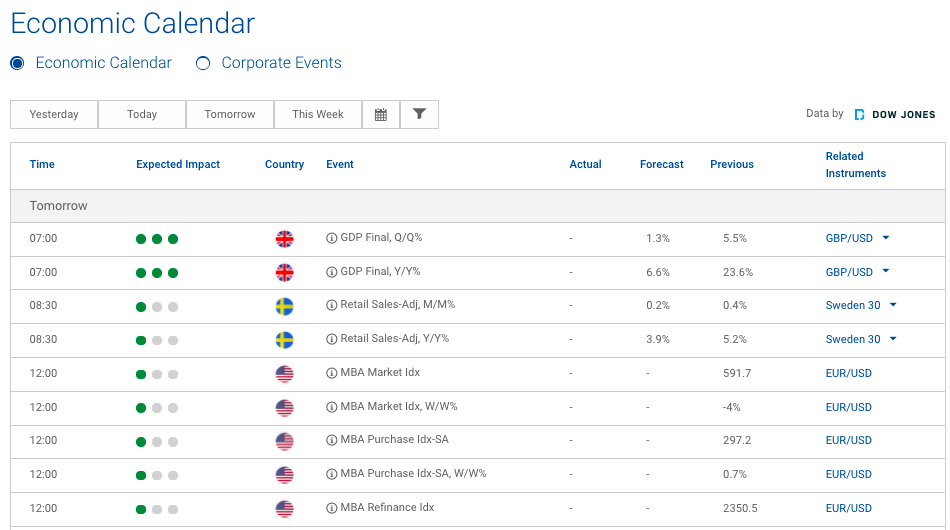
Plus500 has several additional features and tools available on its website to assist with its clients’ trading. These include a financial calendar, news and market insights blogs and a trader’s guide. Additionally, the broker publishes ebooks and insight articles for further market understanding.

Plus500 trading tips

Economic Calendar

Advantages

Benefits to registering for a Plus500 account include:

  • Range of payment methods
  • 2,000 CFDs & options
  • Positive user reviews
  • No scam complaints
  • Scalping supported
  • Safe regulations
  • No hidden fees
  • Crypto trading

Disadvantages

Downsides to a Plus500 account include:

  • No phone support
  • No automated trading
  • Proprietary platform only
  • Market maker execution model

Plus500 Verdict

Plus500 is a reputable online broker that is overseen and regulated by highly rated institutions around the world. The company’s selection of CFD instruments is extensive, spreads are competitive and few non-trading fees are charged. Plus500 offers a range of options for swing trading, scalping and other popular strategies, including cryptocurrency speculation. Check out the broker’s demo account to trial its services and decide whether to open an account.

FAQ

Is Plus500 A Good Broker?

Yes, Plus500 is a CFD broker offering more than 2,000 instruments including indices, forex pairs, shares and cryptocurrencies. Whether Plus500 is the right broker for you or not will depend on a variety of considerations. Be sure to compare key factors like fees, platforms and regulation when choosing the broker best suited to your needs.

Is Plus500 A Market Maker?

Yes, Plus500 is a market maker. This means that the broker will act as the counterpart to all your trades. Plus500 uses a dealing desk which may mean wider spreads than with an ECN broker.

Is Plus500 A Good Platform?

The Plus500 platform is well-designed and has an extensive range of features. However, it is not customisable and does not allow for third-party algorithmic trading. Traders who are comfortable with MetaTrader 4 or cTrader may wish to find a broker that offers these platforms.

Is Plus500 A Margin Account?

Leverage or margin limits with Plus500 depend on your jurisdiction, account type and chosen asset. Typical leverage limits are 1:2 for crypto, 1:10 for commodities and 1:30 for forex pairs.

Is Plus500 A Good App?

The Plus500 app is highly functional and contains all the same features as the WebTrader platform. The application also has high reviews and ratings on the Google Play Store and the Apple App Store.

Airtel Money

Contributor Image
Written By
Contributor Image
Written By
William Berg
William Berg is a legal expert with a focus on securities law and a long track record in the trading industry.
Contributor Image
Edited By
Contributor Image
Edited By
James Barra
James is an investment writer with a strong focus on evaluating swing trading platforms. Drawing on his background in financial services, he brings a clear, analytical perspective. He researches, writes, edits, and fact-checks content across several online trading websites, with an emphasis on broker reviews and educational resources designed for swing traders.
Contributor Image
Fact Checked By
Contributor Image
Fact Checked By
Tobias Robinson
Tobias brings over 25 years of hands-on trading experience across stocks, futures, commodities, bonds, and options. He leads the testing team at SwingTrading.com, focusing on broker reviews and trading tools tailored to the needs of active swing traders.
Updated

Airtel Money is a mobile money service that allows customers to store funds, send and receive payments, pay merchants, and access certain other financial services through a mobile phone. For online traders in several African markets, Airtel Money can provide a practical way to make small-scale deposits and withdrawals to and from an online broker trading account, avoiding the need to fund every transaction through a conventional bank card or bank transfer.

Airtel Money is an electronic wallet linked to a registered mobile number. A customer can add money through authorised agents and other supported channels, then use the wallet for person-to-person transfers, merchant payments, bills, and other financial services, including transfers to and from brokerage accounts. Airtel Africa describes its agent network as a central part of the system, providing locations where customers can load funds onto their phones and convert electronic money back into physical cash.

At the time of writing, Airtel Africa operates across 14 African markets, although the services and payment integrations available to traders vary considerably from one country to another. For the 2025/2026 financial year, Airtel Africa reportedly had over 54 million Airtel Money customers, approximately 2.4 million active agents, and $196 billion in transaction value. Airtel Money is one of several mobile money solutions that have grown large in Africa, alongside mobile-money service providers such as M-Pesa (especially in Kenya), MTN MoMo (especially in Ghana), and Orange Money (especially in in Francophone Africa).

In this guide, we will look at Airtel Money from the perspective of a swing trader in Africa using online brokers. The guide explains how deposits and withdrawals work with Airtel Money, account security, costs, how to pick a suitable broker that accepts Airtel Money, and more.

Airtel Money can be a convenient route for local deposits and withdrawals method for swing traders in African markets where brokers have integrated the wallet. The payment method itself does not improve a trading strategy, but quick local deposits and withdrawals can make account management easier, especially for traders who already receive income and make everyday payments through mobile money.

However, picking a broker simply because it accepts Airtel Money is not the best course of action. The better approach is to choose a properly regulated broker, where the trading platform and the markets available for swing trading suits your preference. Naturally, comparing costs (including things such as spreads, overnight fees, and transaction fees) is also important, as this can vary a lot between brokers.

For retail brokerage companies, this creates an obvious reason to support local mobile money such as Airtel Money and M-Pesa. A trader who already receives wages or business income through a mobile wallet may find a card-only broker unnecessarily difficult to fund, and for many small-scale swing traders, the costs associated with conventional bank transfers would quickly erode profits. Broker integrations with Airtel Money and similar affordable mobile-money services lower the payment barrier between local financial activity and international speculative markets such as forex, commodities, and global equity indices.

With that said, lower payment barriers do not reduce investment risk. In some ways they make disciplined risk management even more important because a trader can move money from an everyday wallet into a leveraged account very quick and with relatively little friction. Mobile money improves financial access while also making it easier to fund a losing trading account in the heat of the moment, and those two effects need to be considered together.

How Airtel Money Works

Airtel Money is an electronic wallet linked to a registered mobile number. A customer can add money through authorised agents and other supported channels, then use the wallet for person-to-person transfers, merchant payments, bills, and certain other financial services. Airtel Africa describes its agent network as a central part of the system, providing locations where customers can load funds onto their phones and convert electronic money back into physical cash.

For a trader, an essential part is of course the connection between the wallet and the broker’s payment processor. If Airtel Money is available for the trader’s account, the trader selects it from the broker’s funding page, enters an amount, and confirms the payment through the registered phone. The trading platform then credits the account after receiving confirmation that the mobile transaction was successful.

The process is similar to using other mobile money services, but Airtel Money and M-Pesa should not be treated as interchangeable. A broker may support both in one country, only one in another, and neither in a third country. Availability can also depend on account currency and the legal broker entity serving the customer, so seeing an Airtel Money logo on a broker’s global site does not prove that the method will appear in every customer’s funding page.

Funding an Airtel Money Wallet

Airtel Money customers can normally add funds through the operator’s agent network and other supported financial channels. Airtel Africa reports approximately 2.4 million active Airtel Money agents across its mobile-money footprint as of the 2025/26 financial year. Agents provide the cash-in and cash-out infrastructure that makes mobile wallets practical even for customers who do not rely heavily on conventional bank accounts and need to be able to convert physical money into digital money and back.

As a trader, make sure the mobile wallet and the phone are registered in exactly the same legal name used for your brokerage account. Discrepancies can cause payment problems, because brokers need to establish where customer funds came from, and names that do not match up can trigger anti-fraud protocols.

Only use your own phone and mobile money wallet. Borrowing another person’s phone and Airtel Money wallet for a deposit can seem harmless, and you might even be able to make a successful deposit. But it is not unusual for withdrawal requests to receive more scrutiny than deposits, and a successful deposit is never a guarantee that the withdrawal will smooth as well.

Where is Airtel Money Used in Africa?

Airtel Money is not exclusively an African service, but Africa is by far its most important market today. At the time of writing, Airtel Africa operates across 14 African markets, although the services and payment integrations vary considerably from one country to another. Airtel Money forms part of a broader move from cash transactions toward digital financial services in African consumer and small business markets.

Airtel Africa states that it had 54.1 million Airtel Money customers as of 31 March 2026, an increase of 21.3% from the previous year, while its agent network reached about 2.4 million. The service is used for merchant payments, transfers, bills, and other financial products.

The most significant markets for Airtel Africa are currently Tanzania, Kenya, Uganda, Zambia, Malawi, Rwanda, and the Democratic Republic of the Congo (commonly known as DRC / Congo-Kinshasa). The minor markets are Nigeria, Niger, Chad, Gabon, Congo-Brazzaville, Madagascar, and the Seychelles.

Tanzania is one of Airtel Money’s most important markets, and the payment service has a long-established and substantial presence in this country. Tanzania is also a country where mobile money in general is widely known and utilized for everyday financial activities. Tanzania is a highly developed mobile-money market, with several competing wallets rather than a single dominant provider.

Kenya is an extremely important mobile-money market, but Airtel is a challenger here, and not the dominant player. Airtel has a significant and growing telecom and mobile-money presence in Kenya, but it competes against the exceptionally strong M-Pesa ecosystem. Airtel has been investing heavily in its distribution network in Kenya in recent years, and the Airtel Money agent network in Kenya increased by 77.9% in 2024/2025.

Airtel is one of Uganda´s major telecommunications operators, and Airtel Money is a well-established part of it´s financial-services business. The service is used for transfers, merchant payments, bills, airtime and other everyday transactions, and there is a large agent/distribution network available.

How to Deposit and Withdraw With an Airtel Money Broker

Depositing into your trading account using Airtel Money

The trader normally begins inside the broker’s secure client portal. Airtel Money is selected from the available payment methods and the deposit amount is entered. Depending on the country and payment processor, the broker may request the registered telephone number, local currency, or another payment detail before initiating the transaction.

A payment prompt or authorisation request is then sent to the phone. The trader should check the amount and exact recipient before entering the Airtel Money PIN. After successful authorisation, a confirmation or transaction reference should be retained.

Check if the money is now visible in the broker account. If the Airtel wallet has already been debited but the trading balance has not updated after some time, contact the broker’s payments team. With the confirmation your saved, you can provide the amount, time, registered number, and transaction reference needed to trace the first transfer.

Withdrawing from your trading account using Airtel Money

Where withdrawals to Airtel Money are supported, the request normally begins inside the broker’s secure client portal. Brokers commonly require money to return through the same payment route used for the original deposit because this helps satisfy payment-security and legal requirements (including mandatory anti-money-laundering and anti-fraud controls). Make sure you keep you Airtel Money wallet active while the trading account is in use, even if you do not plan on making any withdrawal soon.

A swing trader using leverage should always check free margin before requesting a withdrawal. Suppose the account contains $2,000 but $1,400 is supporting open leveraged positions. Removing $1,000 simply because the cash balance appears large will dramatically weaken the margin level. A moderate adverse movement may then cause positions to be closed automatically.

Airtel Money Transaction Times for Traders

Deposits

Airtel Money deposits can be credited rapidly when the broker and payment processor support automated mobile-money transactions. Two examples are FXPesa and Scope Markets, who both describes their supported Airtel Money deposits as instant. In this context, “instant” should still be understood as the normal processing target rather than a guarantee that every payment will appear immediately. Delays can occur because of issues such as mobile network problems, payment-gateway maintenance, or broker compliance checks. A mismatch between the name on the Airtel wallet and the name on the trading account can trigger manual review. The same can happen where a trader suddenly deposits a much larger amount than normally or attempts several transactions in quick succession.

Withdrawals

Withdrawal requests from a trading account often take longer to process than deposits because the broker may review the request before releasing the money, to ensure it complies with internal and external security requirements. This is not unique to Airtel Money withdrawals. Also, traders should distinguish between broker approval time and Airtel Money transfer time. A mobile transfer may be rapid after approval even if it was stuck with the broker for several hours before that, pending a manual review.

FXPesa states that withdrawal requests received before its stated business-day cut-off may be processed the same day, but that first withdrawals can require additional checking.

Airtel Money Fees and Currency Conversion

Airtel Fees

Airtel Money does not have one universal fee structure across Africa. Charges depend on factors such as country/market, transaction amount, transaction type, and whether the transfer is on-network or to another network.

Broker fees

The broker can impose its own transaction processing fee or choose to absorb it. FXPesa currently advertises no broker fee for the Airtel Money routes displayed in its funding table, while Scope Markets states that it does not charge a separate fee on its supported Airtel Money route but that ordinary Airtel Money charges can still apply.

Currency conversion costs

Currency conversion can cost more than the visible payment charge. A trader may for instance send KES, UGX or TZS while maintaining a USD trading account. Somewhere in the payment process the local currency needs to be converted. The rate offered can contain a margin above the underlying foreign-exchange rate, meaning a deposit advertised as fee-free still has a measurable cost. Understanding this is particularly important for swing traders who frequently withdraw profits and then redeposit. Converting from local currency to USD, then back to local currency, then to USD again, and so on, creates repeated foreign-exchange costs. A trader who keeps capital in the brokerage account for several trading cycles incur fewer conversion costs than somebody who moves the same funds back and forth.

Picking a Broker That Accepts Airtel Money

A swing trader should choose a broker based on more than its ability to accept Airtel Money. Mobile funding solves only the movement of cash into and out of the account. The trader also needs to consider factors such as available markets, trading costs, reliable execution, and a suitable regulatory situation. Overnight financing (swap/rollover fees) becomes especially important for swing traders, because some positions may be held open for weeks.

Regulation

Payment convenience should never replace broker verification. A company accepting Airtel Money is not necessarily reputable and properly regulated simply because the payment method is familiar. Traders should identify the exact legal entity holding the account and verify it with the regulator responsible for that jurisdiction. In Kenya, the Capital Markets Authority maintains a public database of licensed financial companies, including non-dealing online forex brokers.

This matters because recognised broker brands can operate several legal entities in different countries, with the various companies typically belonging to the same company group but being subject to different jurisdictions. An international company group may for instance include a CMA-regulated Kenyan company, a South African company regulated by the Financial Sector Conduct Authority (FSCA), a British company regulated by the UK Financial Conduct Authority (FCA), and several other companies regulated in countries known to be more permissive when it comes to trader protection, e.g. Belize, Vanuatu, Saint Vincent and the Grenadines, and the Seychelles. The company named in the client agreement determines which regulator and rules govern the account.

Start by verifying the exact legal broker entity and its regulator. Then visit the regulator to verify the broker is actually licensed by them, and holds an active an appropriate license. Do not follow any links provided by the broker. Find the regulator (financial authority) independently and search their registry yourself. Then, if possible, use the website listed in the registry to start the sign-up process.

Trading strategy, instruments, and costs

Check if the instruments or products required for your strategy are available, and compare factors such as spreads, commissions, overnight fees, available leverage, and stop-out rules.

It is the cost of using your particular strategy that matters. For a swing trader, swap rates can be more important than a tiny difference in the advertised spread. Saving one fraction of a pip at entry means little if a large overnight charge is applied repeatedly during a ten-day position. One of the biggest differences between swing trading and day trading is that swing traders intentionally keep positions open overnight. With leveraged forex and CFDs, this can create financing charges commonly described as swaps, rollover or overnight financing. The exact calculation depends on factors such as instrument, position size, direction of the position, and the number of nights it remains open. A strategy that looks profitable before financing can become much weaker after several days of holding costs. Suppose a trader expects a position to make 1.5% over ten days but pays meaningful overnight charges during that period. The cost is part of the trade and should be included before entry rather than treated as an administrative detail discovered after the position closes. Some instruments can generate positive swap in one direction and negative swap in the other because of interest-rate differences, while others charge financing regardless of the direction. Brokers may also apply a larger rollover on one day of the week to account for weekend settlement. A swing trader should therefore check the contract specification rather than assuming that each night has exactly the same cost.

Platform

Platform also matters. Swing traders often need dependable charting for particular time frames, pending orders, more than one type of stop-loss order, phone alerts, and enough historical data to analyse medium-term market structure. MetaTrader 4 and MetaTrader 5 are common among African forex brokers, while some providers also offer proprietary platforms. The best platform is not necessarily the one with the most indicators for technical analysis, it is the one that allows the trader to execute the planned strategy consistently.

Airtel Money Transfers

The Airtel Money section should be checked for supported markets, currencies, minimum and maximum transactions, withdrawal rules, and any fees charged by either the broker or Airtel Money.

Are traders in your country allowed to use Airtel Money for both deposits and withdrawals with this broker? Access to Airtel Money instant depositing becomes less appealing if withdrawals require an expensive alternative method, e.g. international bank transfer. The complete trading and payment cycle should be considered rather than just one attractive number.

Airtel Money and Margin Management

Mobile money, such as Airtel, can make adding funds to a trading account a quick and easy process. This can both beneficial and dangerous at the same time.

There is a big difference between planned funding and emergency funding/emotional funding. A trader who sticks to a trading plan can use Airtel Money as an ordinary funding tool, in accordance with the monthly trading plan. A trader who acts ad-hoc and repeatedly deposits after losses because positions are approaching a margin close-out is behaving very differently.

  • Planned deposit: “I am adding additional capital for planned trades I’ve already budgeted for.”
  • Emergency deposit: “My trades are losing, so I’m frantically adding money to prevent them from being closed.”

Adding funds to save a losing position does not reduce the market loss. It increases the amount of capital exposed to the same trade. There can be legitimate reasons to increase margin, but the decision should be part of the trading plan. If every adverse movement is followed by another mobile deposit, the wallet has effectively become an extension of the leveraged trading account.

Swing traders can reduce this risk and help maintain discipline by deciding in advance how much money will be allocated to the brokerage account before the trading period begins. If the account reaches a predetermined loss threshold, trading should stop for review rather than immediately drawing another amount from Airtel Money. Convenient payments should make account administration easier, not make loss chasing faster.

The main advantage with Airtel Money is convenience. Fast and easy deposits can be useful before a planned trading week. But a swing trader should not depend on emergency mobile deposits to rescue positions that have moved too far against the original analysis. If the account repeatedly requires fresh money to avoid margin close-outs, the position sizing problem needs to be addressed before the payment method.

The convenience of mobile money creates a behavioural risk that deserves to be taken seriously. If a position loses heavily, a trader can potentially add another deposit from a phone within minutes. This is much easier than visiting a bank office or waiting for a conventional international transfer to go through, and that convenience can become dangerous when the decision is made under pressure.

A swing trader should decide account funding before the trade rather than after it. If $500 has been allocated to a trading strategy, losing $200 should not automatically trigger another $200 Airtel Money transfer. The trader should first establish why the original loss occurred and whether further trading still fits the plan.

Airtel Money Security for Traders

Airtel Money uses account and transaction authentication, but the trader still needs to protect both the wallet and brokerage account. A mobile-money PIN should never be provided to anyone else, including some who is (or is claiming to be) a broker representative, a signal seller, or supposed support employee (Airtel or Brokerage Company. The mere fact that this person is asking for your Airtel Money PIN is a big red flag. A genuine support process may require a transaction reference and identity verification, but another person does not need the customer’s secret PIN to trace a payment.

Unexpected payment prompts are another warning sign. A scammer can impersonate a broker representative and claim that a withdrawal or deposit needs to be confirmed. The customer should only approve a transaction that they initiated and should check the amount and recipient first. A request that appears without an active deposit attempt should be rejected. Do not approve a request simply because the message contains the name of a familiar payment service.

The trading account needs separate protection. A strong password and two-factor authentication should be used where available. Protecting Airtel Money does little good if an attacker can sign into the broker, change account information, or interfere with withdrawal requests. Traders should also protect the email account connected to the broker because email access can sometimes be used to reset trading-account credentials.

The phone (and computer, if applicable) also need to be protected. Keep your phone locked and do not lend it to others if it is used for money management (e.g. Airtel Money) and online trading. Do not allow anyone to get remote access to your device. Deny all requests for screen-sharing. This is true even if you are talking to customer support staff (or alleged customer support staff).

Fraudsters can be very pushy and try to create a situation where you feel very stressed. They want you do act quickly. They do not want you to have time to verify their story independently by actually contacting the relevant entity (broker, Airtel, your bank, police office, etc) through the official channels. They also don´t want you to have time to discuss the matter with a trusted friend, family member, or colleague who might be familiar with this type of scam and recognize the warning signals. Do not fall for manufactured stress.

Pros and Cons of Airtel Money Brokers for Swing Traders

Pros of Airtel Money for Swing Traders

  • Mobile funding can be quick and convenient in countries where Airtel Money is widely used, reducing reliance on cards and international bank transfers.
  • Local-currency payment routes such as Airtel Money can be practical for traders who receive their income in KES, UGX, TZS, or another supported currency.
  • Airtel’s large agent infrastructure in parts of Africa gives customers in these regions a convenient route between physical cash and electronic trading-account funding.
  • Some regulated brokers support both deposits and withdrawals through Airtel Money, allowing traders to return money to the wallet used for funding.

The most useful advantages are practical rather than strategic. Airtel Money can reduce payment friction, but it cannot improve an entry signal or turn an unprofitable swing strategy into a profitable one. Traders should judge the broker primarily on regulation, execution, instruments, costs and overnight trading conditions before treating mobile funding as a deciding factor.

Cons of Airtel Money for Swing Traders

  • Airtel Money availability is country-specific and can differ even within the same brokerage company group and brand.
  • Wallet and transaction limits may make the method inconvenient for larger trading accounts.
  • Some brokers only allow Airtel Money deposits.
  • Currency conversion can add costs where the wallet and brokerage account use different currencies. (This downside is not unique to Airtel.)
  • Fast funding can encourage impulsive deposits after losses or when an account is close to a margin call. (This downside is true for all fast-funding methods.)
  • A broker can change payment processors or remove an Airtel Money route. Traders should maintain another practical withdrawal option.

A trader should also remember that mobile-money acceptance says almost nothing about the quality of the trading conditions. A weak broker can offer a convenient payment method and a strong broker can have a less convenient cashier. The funding method should therefore be considered after the broker has passed the other checks, e.g. regulatory check and trading-cost check.

FAQ

What is an Airtel Money broker?

When we say Airtel Money broker, we do not mean a broker owned by Airtel Africa plc or the Bharti group of India. We means a broker that supports Airtel Money as a deposit method (or deposit and withdrawal method) for at least some customers. Depending on the circumstances, it may be possible to make deposits, withdrawals or both through the mobile wallet. Availability normally depends on the customer’s country, broker entity, and account currency, so support should be checked inside the broker’s current funding section rather than assumed from general reviews or based on Airtel logos on the main broker website.

Is Airtel Money good for swing traders in Africa?

Airtel Money can be a practical payment method for swing traders in supported markets in Africa. The main advantages are security, convenient local funding, and potentially fast withdrawals.

Which brokers accept Airtel Money?

Current examples include FXPesa, which lists Airtel Money across several East African mobile-money routes, IC Markets Kenya, whose product documentation includes Airtel Money among supported country-specific mobile payments, and Scope Markets, which currently documents Airtel Money for eligible Uganda clients. Availability can change, so these examples should be checked directly before a deposit is made.

Can I deposit KES with Airtel Money?

Yes, where the broker supports a Kenyan Airtel Money route. FXPesa currently lists Airtel Money among its KES mobile-money deposit and withdrawal methods. Another broker may accept Airtel Money only in Uganda or Tanzania, so Kenyan support needs to be verified for the individual account rather than inferred from the presence of Airtel Money elsewhere on the broker’s website.

Can I withdraw swing trading profits to Airtel Money?

Yes, if the broker’s Airtel Money integration supports withdrawals in the customer’s country. Brokers often prefer withdrawals to return through the same method used for deposits. Account verification must normally be complete, and the wallet should be registered in the trader’s own name.

Are Airtel Money deposits instant?

They can be. Some brokers currently describe supported Airtel Money deposits as instant, but factors such as technical problems, network outages, and compliance reviews can cause delays.

Does Airtel Money make a broker safe?

No. Airtel Money is a payment service, not a guarantee that the broker is properly regulated and trustworthy. Traders should verify the brokerage company with the relevant financial regulator independently. A familiar mobile wallet should never substitute for evaluating the brokerage company.

Should swing traders keep all their money at the broker?

The account needs enough capital to support planned positions and normal fluctuations without operating constantly near a margin close-out. Capital that is not required for the strategy can be kept elsewhere according to the trader’s own financial plan. Mobile-money withdrawals can make moving smaller amounts convenient, but repeated withdrawals and redeposits may create substantial transaction and currency conversion costs.

Can Airtel Money help during a margin call?

A fast deposit may increase available margin if it reaches the broker in time, but relying on emergency deposits is poor risk planning. Network or payment delays can occur precisely when the trader wants immediate funding. More importantly, adding money does not repair an unsuccessful trade. Swing traders should normally size positions so ordinary market movements can be absorbed without depending on another mobile-money transfer, and there should also be a stop-loss in place.

Before signing up with any broker, make sure you know if your retail account has statutory negative balance protection (NBP), contractual NBP, or no NBP, and what this entails.

About Airtel and Airtel Money

Airtel

The central company is Bharti Airtel Limited, a publicly listed Indian telecommunications group. It is the flagship company of Bharti Enterprises, founded by Sunil Bharti Mittal. Bharti Airtel operates in India and has African operations through its ownership of Airtel Africa.

At 31 March 2025, Bharti Airtel’s largest shareholder was Bharti Telecom Limited, with 40.47% of Bharti Airtel. Bharti Telecom is part of the promoter structure associated with the Bharti/Mittal group. Bharti Airtel itself was 52.42% promoter/promoter-group owned at that date. 

The story starts with Bharti Enterprises, founded by Sunil Bharti Mittal in Indian in 1976. It was initially a diversified entrepreneurial group, not a telecom company. Airtel

Bharti subsequently moved into telecommunications, and Bharti Telecom Limited was incorporated in 1985. Bharti Telecom is controlled by the Bharti family, ultimately through Bharti Enterprises (Holding) Private Limited and family trusts.

Airtel Money

Airtel Money is ultimately controlled by the Bharti group of India, through Bharti Airtel and its African subsidiary Airtel Africa plc. As of June 2026, Bharti Airtel increased its effective ownership of Airtel Africa to about 79.22%, giving it clear control. The ultimate controlling entity is Bharti Enterprises (Holding) Private Limited, which is controlled by trusts associated with the Bharti family, including the family of Sunil Bharti Mittal. 

The ownership structure is roughly:

  • Bharti Enterprises / Bharti family
    ↓
  • Bharti Airtel Limited (India)
    ↓
  • Airtel Africa plc
    ↓
  • Airtel Mobile Commerce B.V. (AMC BV)
    ↓
  • Airtel Money operations across Africa

Airtel Africa’s 2026 annual report identifies Airtel Mobile Commerce B.V. (AMC BV) as the holding company for Airtel Africa’s mobile-money operations outside Nigeria. Airtel Mobile Commerce B.V. (AMC BV) is the holding company for Airtel Africa’s mobile-money operations except the Nigerian payment service bank (PSB) operations. For Nigeria, the key entity is Airtel Mobile Commerce Nigeria Limited (AMCN), which operates Airtel Money in Nigeria.

Airtel Money itself isn’t simply one company operating identically in every African country. The wallet services are operated through local companies and subject to national law, which matters when you’re looking at things such as forex broker transfers, fees, licensing, and whether Airtel Money can fund a particular broker in your country.


Best Swing Trading Brokers For Funded Accounts 2026

Contributor Image
Written By
Contributor Image
Written By
Christian Harris
Christian is an experienced swing trader with years actively trading stocks, futures, forex, and cryptocurrencies. He focuses on short- to medium-term strategies, combining technical analysis with disciplined risk management. His real-world trading experience helps him provide valuable perspectives for aspiring swing traders.
Contributor Image
Edited By
Contributor Image
Edited By
James Barra
James is an investment writer with a strong focus on evaluating swing trading platforms. Drawing on his background in financial services, he brings a clear, analytical perspective. He researches, writes, edits, and fact-checks content across several online trading websites, with an emphasis on broker reviews and educational resources designed for swing traders.
Contributor Image
Fact Checked By
Contributor Image
Fact Checked By
William Berg
William Berg is a legal expert with a focus on securities law and a long track record in the trading industry.
Updated

Swing trading with a funded account differs from trading with your own money. The broker you use has to match the way funded programs work. If it doesn’t, you’ll run into limits that can eat into profits or break the rules of your program.

We’ve reviewed the best brokers that work with funded accounts and highlighted the ones that best fit swing trading.

Holding Trades Overnight

Swing traders typically need to keep trades open for several days, sometimes even weeks. Some brokers that work with funded programs don’t allow this. Others charge higher swap or rollover fees.

Before you choose, check:

  • Can you hold positions overnight without breaking rules?
  • Are there higher costs for long holds?
  • Does the program cut leverage for overnight trades?

💡
If overnight trades aren’t supported, the account may not work for swing trading.

Weekend Holding Rules

Some funded accounts force you to close positions before Friday’s market close. This eliminates many swing strategies because setups often require days to unfold.

Ask yourself:

  • Does the broker allow holding over the weekend?
  • Are there special restrictions, such as reduced lot sizes?
  • Is there a fee or penalty for leaving trades open?

💡
As a swing trader, you need the option to ride through weekends without breaking rules.

Leverage & Position Sizing

Swing trading relies less on extreme leverage than scalping. However, leverage still matters because funded accounts often have relatively small balances compared to their targets.

Check for:

  • Is leverage high enough to size trades without overexposing?
  • Does the program reduce leverage for specific pairs or during news events?
  • Are there minimum lot sizes that make risk control harder?

💡
Leverage rules should give enough room to trade safely, but not force oversized bets.

Spread & Swap Costs

Costs hit swing trading in two ways: spreads and swaps.

  • Spreads affect entries and exits.
  • Swaps matter when holding for days.

💡
A slight spread difference may not matter much for long holds, but a bad swap rate can eat up profit.

Compare:

  • Average spread on pairs you trade most.
  • Positive vs negative swaps. Some brokers flip them in a way that makes holding expensive.

Low costs keep trades flexible.

On funded accounts I’ve traded, spreads are manageable because entries aren’t as frequent in swing trading. The real drain comes from swaps—holding a position overnight with a negative rate can eat into profit faster than expected. Over the course of a week or two, those charges add up enough to change whether a setup is worth holding.
author image
Christian Harris
Author

Slippage & Execution

Execution speed is not just a problem for scalpers. Swing traders often set stop orders or enter around breakout levels. Slippage can cause entries to be pushed further away than planned.

Ask:

  • Does the broker maintain stable execution during volatile market conditions?
  • How wide is slippage during news or low liquidity?

💡
Even if you hold trades for days, a bad fill can change the setup.

Data Feeds & Chart Reliability

Swing trading depends on accurate chart history and clean price feeds. Funded accounts sometimes connect to brokers with odd feeds. A candle that appears differently between brokers can alter the entire setup.

Check:

  • Does the broker feed match widely used price data?
  • Are charts reliable when markets move fast?
  • Are there frequent disconnects?

You need charts you can trust to plan entries and exits.

Trading on MT5 WebTrader

MT5 WebTrader is an easy-to-use platform that runs in your browser

Program-Specific Broker Choice

Some funded account providers lock you into a specific broker. Others give you options. If you’re locked in, the choice is simpler—you work with what’s offered. But if you can choose, weigh the rules against your style.

Key questions:

  • Does the funding firm choose the broker, or can you link your own?
  • Do you get the exact account terms if you switch brokers inside the program?
  • Are demo and live feeds consistent?

💡
If the program is strict, you may have to adjust your strategy to fit the broker.

Risk Rules That Affect Swing Trades

Funded accounts have rules on daily loss, max drawdown, or news trading. Even if the broker supports swing trades, these rules can block you.

Check for:

  • Do daily loss limits reset if you hold trades overnight?
  • Is the floating drawdown counted against the daily loss?
  • Are there bans on holding through news events?

💡
A swing trade may last through multiple events, so the rules need to match that reality.

Instrument Access

Not every broker tied to a funded program offers the same pairs or markets. As a swing trader, you may prefer to trade majors, minors, commodities, or indices.

Look at:

  • Are the pairs you trade most available?
  • Do exotic pairs come with extreme costs that make swing trades unworkable?
  • Is the product list broad enough to find clean setups on a regular basis?

💡
A limited instrument list narrows your options and may force trades you’d rather skip.

Broker Stability & Support

Funded trading is already stressful due to its strict rules. A broker with unstable platforms or slow support exacerbates the issue.

Consider:

  • Does the trading platform crash during peak hours?
  • How fast does support respond if something breaks mid-trade?
  • Is there a clear record of payouts and withdrawals?

💡
Even if the rules fit swing trading, the broker still needs to be dependable.

Demo Vs Live Differences

Most funded accounts start with a demo evaluation. Then, if you pass, you move to live or simulated funded accounts. Sometimes, execution, spreads, or swaps change when you go live.

Think about:

  • Is execution the same between demo and live?
  • Do swap rates shift once you’re funded?
  • Are spreads consistent across phases?

💡
You want to avoid changing your strategy just because the account type switches.

Platform Choice

Some brokers only connect with MetaTrader 4 (MT4) or MetaTrader 5 (MT5). Others offer cTrader, TradingView, or proprietary platforms. Swing trading can work on any, but you may prefer one for charting or automation.

Check:

  • Is the platform stable for longer-term trades?
  • Can you backtest swing setups easily?
  • Do you trust the platform data for planning?

💡
The broker’s trading platform should support your workflow, not limit it.

Final Thoughts

The best broker for swing trading with a funded account isn’t about big promises or fancy features. It ultimately comes down to whether the broker aligns with your trading style and the rules of the funding program.

If you can hold trades overnight and through weekends, manage costs without spreads or swaps eating into profits, and rely on stable execution and data feeds, then the broker is likely a good fit. It also helps if the platform is stable and the account rules don’t hinder the way swing trades actually play out.

In the end, the right choice is the one that lets you trade the way you already trade—without forcing you to adjust your strategy just to fit the broker. That’s what makes a broker truly suitable for swing trading with a funded account.

Best Swing Trading Brokers For Cent Accounts 2026

Contributor Image
Written By
Contributor Image
Written By
Christian Harris
Christian is an experienced swing trader with years actively trading stocks, futures, forex, and cryptocurrencies. He focuses on short- to medium-term strategies, combining technical analysis with disciplined risk management. His real-world trading experience helps him provide valuable perspectives for aspiring swing traders.
Contributor Image
Edited By
Contributor Image
Edited By
James Barra
James is an investment writer with a strong focus on evaluating swing trading platforms. Drawing on his background in financial services, he brings a clear, analytical perspective. He researches, writes, edits, and fact-checks content across several online trading websites, with an emphasis on broker reviews and educational resources designed for swing traders.
Contributor Image
Fact Checked By
Contributor Image
Fact Checked By
Tobias Robinson
Tobias brings over 25 years of hands-on trading experience across stocks, futures, commodities, bonds, and options. He leads the testing team at SwingTrading.com, focusing on broker reviews and trading tools tailored to the needs of active swing traders.
Updated

A cent account makes it easier to start small, since your balance shows in cents and lets you manage risk with tiny steps. However, not every broker’s cent account is well-suited for swing trading.

Dig into our pick of the best swing trading brokers with cent accounts – tested by our experienced traders and industry experts.

How SwingTrading.com Chose The Top Cent Accounts

We selected the best cent accounts by first sorting brokers by their overall ratings, blending key swing trading data points, such as spreads, execution quality, and leverage options, with our team’s hands-on testing insights.

This combination of quantitative analysis and practical experience ensured our recommendations reflect both performance metrics and real-world usability.

What To Look For In A Cent Account

Swap & Overnight Costs

Swing traders almost always face overnight charges. Every time you roll a position past midnight, the broker applies a swap fee. Some pairs might even give you a small credit, but most of the time you’ll be paying.

On a cent account, these costs can look small at first, but they stack up quickly if you hold trades for a week or two. A strategy that looks profitable on paper can lose its edge once swaps are included.

What to look for:

  • A broker that posts clear daily swap rates.
  • Information on how rates are calculated.
  • Options for swap-free accounts, if available.

If the broker hides swap details or changes them often, it’s harder to plan swing trades with confidence.

I didn’t notice overnight charges on my account at first, but after holding forex trades for a week, the swaps added up and taught me to factor time into every plan.
author image
Christian Harris
Author

Execution Quality

Fast execution isn’t as critical for swing trading as it is for scalping—still, order quality matters. If a stop order doesn’t trigger where you planned, you could end up with a worse entry or a bigger loss.

On cent accounts, some brokers run trades on less expensive infrastructure, which can result in more re-quotes or slippage. Over a series of trades, this adds up.

What to look for:

  • A record of stable execution with minimal delays.
  • Limit and stop orders triggering correctly.
  • Few complaints about re-quotes.

Smooth execution won’t make or break every trade, but it keeps your strategy consistent.

Spreads & Commissions

Every trade starts with a cost: the spread. For swing trading, this isn’t as painful as for scalpers, since you aim for bigger targets. Still, wider spreads on cent accounts can reduce your profit margin.

Some brokers also add extra markups on cent accounts. You might see spreads double compared to their standard accounts.

What to look for:

  • Transparent spread tables for cent accounts.
  • Comparison with the broker’s standard account.
  • Commission-free trading that doesn’t come with inflated spreads.

💡
Lower spreads and commissions mean more room for your swing trades to breathe. Pay attention to both entry and exit costs, and compare spreads across different brokers before committing. Even small differences can add up over multiple trades

Position Size Flexibility

The biggest draw of a cent account is the ability to trade with very small lot sizes. This helps when you want to test swing setups without risking much. You can scale into trades slowly or manage risk with more precision.

What to look for:

  • Brokers that allow micro (0.01) or nano (0.001) lots.
  • Clear minimum trade sizes.
  • The ability to add or reduce positions in small steps.

The more flexible the trade size, the easier it is to practice good risk management.

Trading swings on a cent account taught me patience. The profits were tiny, but so were the mistakes—and that space to practice without fear was worth more than the cents themselves.
author image
Christian Harris
Author

Margin & Leverage

Swing trading means holding trades overnight, so margin is tied up for longer. The level of leverage on cent accounts affects how many trades you can keep open.

Too much leverage can be dangerous, but too little can limit you. A balanced level gives you flexibility without forcing you to over-commit.

What to look for:

  • Leverage levels that suit your style (not just the maximum advertised).
  • Margin call rules—when the broker starts to close trades.
  • Whether leverage differs between instruments.

A clear margin policy helps avoid nasty surprises when trades run longer than expected.

Trading with leverage on a cent account showed me both sides of the coin—the freedom to open more positions and the risk of watching them vanish just as quickly.
author image
Christian Harris
Author

Platform Stability

Swing traders don’t need advanced tools, but they do need a stable, reliable platform. Crashes or outages at the wrong time can block you from adjusting trades.

What to look for:

  • Access to MetaTrader 5, cTrader, TradingView, or another established platform on cent accounts.
  • A mobile app that works smoothly.
  • Basic charting tools for tracking support, resistance, and moving averages.

Even simple setups need clear charts and stable order handling.

Swing Trading oil on TradingView

TradingView stays stable for cent account trades, keeping charts and orders reliable

Instrument Range

Not every cent account offers the same instruments as a standard account. Sometimes, only a few forex pairs are available. If your swing strategy needs specific markets, check availability early.

What to look for:

  • Access to forex majors and minors.
  • Whether metals, indices, or commodities are offered in cent mode.
  • Swap and spread details for each instrument type.

The right mix of instruments lets you adapt to changing market conditions.

On my cent account, I realized the choice of instruments was limited—it pushed me to master a few pairs instead of chasing every market.
author image
Christian Harris
Author

Risk Management Tools

Swing trading is all about patience, but patience without risk control is risky. Stop losses, take profits, and trailing stops are essential.

What to look for:

  • Guaranteed support for stop-loss and take-profit orders.
  • Trailing stop functions that work on cent accounts.
  • Any limits on the number of orders or modifications allowed.

💡
Good tools let you manage risk even if you’re not at the screen every hour. Use stop-loss and take-profit orders, and consider trailing stops to lock in gains as a trade moves in your favor.

Deposits & Withdrawals

Most traders use cent accounts to start small. That means you need flexible funding options. If the broker sets high withdrawal minimums, it defeats the purpose.

What to look for:

  • Low minimum deposit and withdrawal amounts.
  • Clear fee structures for small transfers.
  • Reasonable processing times.

💡
Start with deposits you’re comfortable risking and practice withdrawing small profits regularly. This helps you stay disciplined, test strategies without stress, and avoid locking up money unnecessarily.

Broker Policy On Cent Accounts

Some brokers treat cent accounts as a secondary product, rather than a full trading option. They may restrict features, limit instruments, or raise spreads.

What to look for:

  • A cent account that works like a standard account in every way except balance size.
  • No restrictions on order types.
  • Consistent leverage and execution quality.

The goal is to trade, usually, just with smaller steps.

Final Thoughts

Swing trading with a cent account makes sense for many traders. It allows you to hold trades for days without risking much money, while still working in real market conditions.

However, not all cent accounts are the same. The details—swap costs, spreads, execution, margin rules, and platform stability—shape whether your trades succeed or not. A cent account is only helpful if the broker treats it fairly and provides the same quality as standard accounts.

Take the time to check these points before you choose. The best swing trading broker for cent accounts gives you space to practice, refine your strategy, and trade swing setups with confidence.

Best Swing Trading Brokers For Micro Accounts 2026

Contributor Image
Written By
Contributor Image
Written By
Christian Harris
Christian is an experienced swing trader with years actively trading stocks, futures, forex, and cryptocurrencies. He focuses on short- to medium-term strategies, combining technical analysis with disciplined risk management. His real-world trading experience helps him provide valuable perspectives for aspiring swing traders.
Contributor Image
Edited By
Contributor Image
Edited By
James Barra
James is an investment writer with a strong focus on evaluating swing trading platforms. Drawing on his background in financial services, he brings a clear, analytical perspective. He researches, writes, edits, and fact-checks content across several online trading websites, with an emphasis on broker reviews and educational resources designed for swing traders.
Contributor Image
Fact Checked By
Contributor Image
Fact Checked By
Tobias Robinson
Tobias brings over 25 years of hands-on trading experience across stocks, futures, commodities, bonds, and options. He leads the testing team at SwingTrading.com, focusing on broker reviews and trading tools tailored to the needs of active swing traders.
Updated

Micro accounts let you trade smaller lot sizes and limit risk while you learn or test strategies. But our tests show not every micro account broker is worth your time.

That’s why we’ve rounded up the best micro account brokers for swing traders.

How SwingTrading.com Chose The Top Micro Accounts

We identified the best micro accounts by ranking brokers based on overall ratings, then combining relevant trading data points, including spreads, trade execution, and account flexibility, with our team’s hands-on testing insights.

This balanced approach ensures our picks reflect both measurable performance and practical trading experience.

What To Look For In A Micro Trading Account

Trade Size Flexibility

The whole point of a micro account is trading in small sizes. Not all brokers let you do this properly. Check if the broker supports micro lots (0.01 lot). Some even allow nano lots (0.001 lot).

The smaller the lot, the more precise you can be with risk. This is especially useful in swing trading, where stop losses can be wide. Without small lot options, you’ll risk too much per trade.

For example, if your account has $200, trading a full lot isn’t possible. However, with micro lots, you can risk just $1 to $2 per trade. This lets you stay in the game longer while testing your system.

TopFX micro lot

You can trade at TopFX with positions starting from just 0.01 lots

Spreads & Costs

Swing traders don’t trade as often as scalpers, but costs still add up. Every spread and commission eats into profit.

Micro accounts usually come with wider spreads than standard accounts. Compare spreads across brokers, especially on the pairs or markets you want to trade. Even a few tenths of a pip matter if you plan to hold multiple trades at once.

Imagine you open three trades across different pairs, each held for a week. A wider spread on all three could take $5 to $10 off your profit. That’s meaningful when your account is small.

Swap & Overnight Fees

Because swing trades last days or weeks, swap charges matter. Swap is the fee or credit you pay for holding a trade overnight. Some pairs have positive swaps, but many don’t.

A small negative swap may not hurt much on a short hold, but over weeks, it stacks up. Always check how the broker handles swaps on micro accounts. Some brokers offer swap-free options, but read the fine print to see if other fees replace them.

For instance, if you hold EUR/USD short for 14 nights and the swap is –$0.10 per micro lot, that’s $1.40 gone. On a small account, it matters.

Using a micro account for swing trading showed me how costs quietly eat into gains. Even small spreads and overnight fees matter when you hold trades for several days. It forced me to plan each move carefully and focus on setups that really make sense, instead of chasing every signal.
author image
Christian Harris
Author

Order Execution Speed & Reliability

You won’t need split-second execution like a day trader. But you still need orders to fill at the price you set.

Swing traders often use pending orders, like buy stops or sell limits. If the broker delays execution or slips prices, it changes your risk.

Ensure the broker has a proven track record of consistent execution. This is especially key in fast-moving markets.

Platform & Tools

Swing traders need good charting. You’ll want to see daily, 4-hour, and weekly timeframes with clarity. A basic platform with limited charting capabilities makes analysis more challenging.

Look for brokers that offer solid charting tools. MetaTrader 4 (MT4), MetaTrader 5 (MT5), cTrader, or TradingView integrations are standard.

Also, check if you can use alerts, templates, or indicators you rely on. The platform should let you manage trades without friction.

Trading a micro account on cTrader

Test strategies on cTrader with small micro lot positions before scaling up

Risk Management Features

Swing trades last longer, so a broker with excellent risk management tools is critical. You need stop losses and take profits that actually trigger at your set levels.

Some brokers have slippage issues, even on stops. Others may not offer guaranteed stop-losses on micro accounts.

Make sure the broker lets you control your exits without hidden limits. Being able to adjust trade size down to the micro lot is most important.

Account Minimums & Funding

Micro accounts are meant for small deposits. Check the minimum deposit requirement. Some brokers advertise micro accounts, but then require high deposits to open one. Others allow starts for $5 or $10.

Funding methods for trading also matter globally. Not every trader can use the same payment systems. Confirm the broker accepts the deposit and withdrawal methods you can actually use.

Leverage Options

Swing trading often needs wider stops. That makes leverage a factor. High leverage lets you place trades without tying up your whole balance. But with a micro account, you also want to avoid overleveraging.

Check if the broker offers flexible leverage settings. Too low leverage can block trades. Too high leverage can tempt mistakes. The right broker gives you a choice.

Market Access

Not all brokers offer the same markets on micro accounts. Some limit instruments to major forex pairs only. Others extend micro trading to indices, commodities, or even crypto.

As a swing trader, you may want more than just EUR/USD. Wider access gives you flexibility. Before opening an account, confirm which instruments are actually tradeable in micro size.

Scaling Up

A micro account often serves as a stepping stone. You start small, build skill, then grow. It’s worth checking how easy it is to scale up with the same broker.

Can you switch to a standard account without hassle? Will trading conditions improve as your balance grows? A broker that supports growth saves you from moving accounts later.

Trading swing setups on a micro account taught me patience more than anything else. The profits looked tiny at first, but the small size kept me from blowing up when a trade went wrong. It’s not glamorous, but it’s the most honest way I found to learn how swings actually play out over days and weeks.
author image
Christian Harris
Author

Example Swing Trade Using A Micro Account

Let’s walk through a simple trade. Say you open a micro account with $250. You decide to trade EUR/USD.

  • Analysis: On the daily chart, you see the pair bouncing off support at 1.0800. You believe it will climb back to 1.1000 in the next two weeks.
  • Entry: You place a buy at 1.0820 with a stop loss at 1.0750 and a take profit at 1.1000.
  • Position size: You choose 1 micro lot (1,000 units). At this size, each pip is worth about $0.10.
  • Risk: Your stop loss is 70 pips below entry. That’s a risk of $7 (70 x $0.10). This equals less than 3% of your $250 account—reasonable for a swing trade.
  • Reward: If price hits 1.1000, that’s 180 pips of profit, or about $18. You’re risking $7 to make $18, which is a decent ratio.

Over the 10 days you hold the trade, you pay a total of –$1.20 in negative swap. Your trade closes at the target, giving you a net gain of $16.80. On a $250 account, that’s about a 6.7% return on one trade, without risking too much.

This example illustrates why micro accounts are beneficial. You manage risk in small dollar amounts, but still take meaningful trades. With larger positions, you could have risked too much on the same setup.

Bottom Line

Choosing the best broker for swing trading with a micro account isn’t about hype. It’s about the basics: trade size control, fair costs, stable platforms, and access to markets.

Micro accounts are meant to limit risk and give flexibility while you grow. Focus on the details that matter most to swing trading—overnight costs, lot sizes, and order reliability.

If a broker checks these boxes, you’ll have a smoother start and a setup that supports your trading style.

Best Swing Trading Crypto Brokers 2026

Contributor Image
Written By
Contributor Image
Written By
Christian Harris
Christian is an experienced swing trader with years actively trading stocks, futures, forex, and cryptocurrencies. He focuses on short- to medium-term strategies, combining technical analysis with disciplined risk management. His real-world trading experience helps him provide valuable perspectives for aspiring swing traders.
Contributor Image
Edited By
Contributor Image
Edited By
James Barra
James is an investment writer with a strong focus on evaluating swing trading platforms. Drawing on his background in financial services, he brings a clear, analytical perspective. He researches, writes, edits, and fact-checks content across several online trading websites, with an emphasis on broker reviews and educational resources designed for swing traders.
Contributor Image
Fact Checked By
Contributor Image
Fact Checked By
Tobias Robinson
Tobias brings over 25 years of hands-on trading experience across stocks, futures, commodities, bonds, and options. He leads the testing team at SwingTrading.com, focusing on broker reviews and trading tools tailored to the needs of active swing traders.
Updated

Crypto brokers provide swing traders with a more secure and streamlined way to trade assets like Bitcoin and Ethereum, without being burned by bankrupt platforms or headline-making collapses.

We’ve tested and compared the top players to bring you the best crypto brokers for 2026.

How SwingTrading.com Chose The Best Crypto Brokers

Our ranking of the best crypto trading platforms is driven by SwingTrading.com’s in-depth broker scoring system, built on over 200 data points.

For traders using contracts for difference (CFDs), we’ve drilled into more than eight specialized criteria to highlight brokers that truly support CFD strategies.

Key factors include competitive spreads on high-volume crypto pairs, leverage flexibility, and bonus offers tailored to active CFD traders.

The platforms featured here didn’t just pass the basics—they excelled in core CFD metrics and real-world usability, based on extensive hands-on testing.

What Is A Crypto Broker?

A crypto broker is a platform or firm that allows you to buy, sell, and trade cryptocurrencies through a user-friendly interface.

Unlike crypto exchanges that match buyers and sellers directly, brokers often act as intermediaries, offering fixed prices and instant execution.

Many also provide additional tools, such as leverage, advanced charting, and access to derivatives like crypto CFDs, which allow you to speculate on price movements without owning the actual asset.

For swing traders, crypto brokers are beneficial because they streamline the trading process while offering key features that suit medium-term strategies.

Most brokers provide access to technical analysis tools, economic calendars, and market news—all important for identifying and managing multi-day trading setups.

💡
The ability to hold positions overnight or across several days, often with adjustable leverage, fits well with the timeframes and tactics that swing traders use to capture price swings.

Moreover, some crypto brokers offer practice accounts and demo trading competitions, allowing you to test strategies in realistic conditions before committing real capital.

With around-the-clock market access and a growing list of tradable cryptocurrency pairs, crypto brokers provide swing traders with the flexibility and resources needed to navigate the highly volatile world of cryptocurrency trading effectively.

Crypto Broker vs Exchange

For swing traders, understanding the distinction between a crypto broker and a crypto exchange is crucial when selecting the optimal trading environment.

A crypto broker simplifies the process by acting as an intermediary between you and the market. Instead of matching your order with another trader’s, the broker sets the price and executes the trade instantly.

This can be beneficial if you value convenience, faster execution, and access to additional features such as leveraged trading, advanced charting tools, and risk management options.

Many brokers also offer demo accounts and responsive customer support, making them appealing if you want to develop and refine your multi-day trading strategies.

💡
Crypto brokers offer a more user-friendly, all-in-one platform, while crypto exchanges provide more granular control and direct market access.

In contrast, a crypto exchange is a decentralized marketplace where traders buy and sell cryptocurrencies directly with one another. Prices are determined by real-time supply and demand, resulting in better spreads and greater transparency.

Crypto exchanges may benefit from deeper liquidity and more control over order types, such as limit or stop orders, which can be crucial for executing precise entries and exits over several days.

However, in our experience, exchanges often have steeper learning curves, less personalized support, and may require you to manage wallets and withdrawals manually.

The best choice depends on whether ease of use or execution flexibility is more important to your swing trading strategy.

How To Select A Top Crypto Broker

Regulation & Safety

Security isn’t optional—it’s your first line of defense. As a swing trader, you’re holding positions over days or weeks, which means your funds may sit on a platform longer than a day trader’s.

This makes the integrity of your broker’s security setup critically important. You want brokers that use cold storage for the majority of client assets, keeping funds offline where they’re safe from hacks. Without it, you’re essentially parking your money in a high-risk zone.

Two-factor authentication (2FA) is another must-have. Strong brokers will require 2FA not just for logins, but also for withdrawals and key account changes. It’s a simple step that massively reduces the risk of unauthorized access. Some brokers also offer biometric login or allow integration with hardware wallets for even greater control.

💡
Regulation matters more than ever. With crypto still shaking off the aftershocks of scandals like FTX, a properly regulated broker offers peace of mind.

Look for platforms licensed by credible regulatory bodies, such as the FCA in the UK, ASIC in Australia, or CySEC in Europe. Regulation requires brokers to adhere to strict client fund segregation, financial reporting, and operational transparency rules, thereby safeguarding your capital from mismanagement or outright fraud.

Insurance adds another layer of protection. Some top-tier brokers offer coverage for digital assets held in custody, which can reimburse losses resulting from events such as cyberattacks.

While this isn’t a replacement for strong security practices, it serves as a valuable safety net, especially when your capital is exposed during volatile price swings.

Fees, Spreads & Commissions

Fees and spreads can make or break your swing trading profits. While you’re not trading minute-by-minute like scalpers, you’re still entering and exiting positions frequently enough for costs to add up fast.

Every trade you make—buying or selling—comes with either a direct commission or a spread (the difference between the bid and ask price). If those spreads are wide or fees are high, your breakeven point increases, which eats into potential returns.

Low spreads on major cryptocurrency pairs, such as BTC/USD or ETH/USDT, are especially important.

As a swing trader, you’re typically targeting gains of 5–20% over several days or weeks. If your broker charges a wide spread—say, 2%—you’re starting each trade at a loss, making it harder to hit your targets.

💡
Tight, consistent spreads allow for more efficient entries and exits, which is crucial when timing swing trades based on short- to mid-term price patterns.

Watch for hidden costs, too. Some brokers lure you in with zero-commission marketing but make up for it through inflated spreads or excessive withdrawal fees. Others charge inactivity fees or extra fees for using certain features, such as advanced charting or leverage.

Always check the entire fee structure—including overnight financing costs (such as swap or rollover fees) — if you plan to hold CFD positions over multiple days.

The best crypto brokers for swing trading keep costs transparent and competitive, allowing you to focus on market moves without worrying about whether your broker is quietly draining your edge.

FP Markets crypto spreads

FP Markets lists its spreads for all tradable crypto coins on its website

Crypto Markets

The range and quality of crypto assets available can directly shape your swing trading opportunities.

A good broker should offer more than just Bitcoin and Ethereum. As a swing trader, you benefit from having access to a diverse set of assets, especially mid-cap and emerging coins that tend to show more substantial, more frequent price swings than the larger, more stable tokens.

These altcoins can offer sharper technical patterns and greater short-term volatility, which are prime conditions for swing setups.

Market depth and liquidity are just as critical. You need to be able to enter and exit trades efficiently without significant slippage.

A broker connected to deep liquidity pools or offering tight spreads on a wide range of crypto markets ensures that your trades execute close to your intended price, even during volatile sessions.

Poor liquidity, on the other hand, can erode gains or force you to hold positions longer than planned, increasing your risk exposure.

Swing traders also benefit from brokers that support multiple trading pairs and instruments. Look for platforms offering both spot and derivative products (like crypto CFDs or perpetual contracts) so you can trade long or short, depending on your market outlook.

Some brokers even offer synthetic pairs or cross-crypto trades, providing more flexibility in your trading strategies.

The more robust and versatile a broker’s crypto offering, the more tools and opportunities you’ll have to execute profitable swing trades. Choose a platform that doesn’t just list coins—it supports active trading across them with speed, variety, and precision.

eToro cryptocurrencies

eToro offers over 130 different cryptos, including altcoins and meme coins

Trading Software

A broker’s trading platform can make or break your swing trading experience. Whether you’re holding positions for a few days or a couple of weeks, you need powerful tools for technical analysis, seamless execution, and precise risk management.

This is where platform choice becomes critical. Some brokers offer access to well-known third-party platforms like MetaTrader 4 (MT4), MetaTrader 5 (MT5), cTrader, or even TradingView integration—all of which are packed with features that experienced swing traders rely on.

MT4 and MT5 are industry staples, especially for traders who value advanced charting, expert advisors (EAs), and custom indicators.

MT5 builds upon MT4 with additional timeframes, economic calendars, and enhanced market depth—ideal for swing traders seeking detailed analysis across multiple pairs or assets.

cTrader, on the other hand, offers a sleek interface with Level II pricing, excellent order management, and fast execution, making it a strong choice for technically inclined traders.

TradingView stands out for its visual appeal and extensive community-driven content. Suppose you’re someone who follows or shares trade ideas, or you rely heavily on layered chart setups. In that case, TradingView’s web-based platform offers maximum flexibility, with many brokers now providing direct trading integration.

Meanwhile, many brokers also provide proprietary platforms, which can vary widely in quality. The best ones offer modern interfaces, built-in news feeds, price alerts, and mobile functionality tailored to crypto markets. However, they may lack the depth or customizability of the leading third-party platforms.

Trading BTC/USD on TradingView

TradingView provides powerful charts and real-time crypto market insights

Unique Selling Points

Our testing shows not all crypto brokers are created equal, and it’s often the extra features that separate the good from the great.

Specialized tools such as AI-powered analytics, trading signals, or pattern recognition can help you identify high-probability swing setups more quickly.

These features can save you hours of chart scanning and boost your ability to act on momentum shifts or breakout opportunities before the crowd catches on.

Educational resources are another underrated edge. A broker that offers in-depth market insights, video tutorials, or strategy breakdowns tailored to swing trading can sharpen your skills over time.

The more you understand market behavior and risk management, the better your trading decisions become. Some platforms even provide weekly technical outlooks or sentiment analysis that can help frame your trades within the bigger picture.

Social trading and copy trading can also add value, especially if you’re still developing your strategy. These features enable you to follow or mirror more experienced traders, providing a real-time view into how they structure their trades.

It’s not just a shortcut—it’s a chance to learn by observation, refine your timing, and diversify your exposure without manually tracking every opportunity yourself.

A broker’s unique features shouldn’t be treated as fluff—they can give you a serious tactical advantage. When combined with solid execution and fair pricing, these extras can help you trade smarter, not just harder.

What sets excellent crypto brokers apart for me isn’t just the tutorials—it’s the way their educational material breaks down real trade scenarios with charts, timing strategies, and risk setups that match how swing traders think. It feels less like theory, more like trading with a coach.
author image
Christian Harris
Author

Customer Support

Reliable customer support can be a lifeline when you’re managing live positions. As a swing trader, you might not be glued to your screen 24/7, but when something goes wrong—like a delayed withdrawal, order execution issue, or unexpected platform error—you need answers fast.

A broker with responsive, knowledgeable support can make the difference between a minor hiccup and a costly mistake. Waiting hours or days for a reply can cost you more than just convenience—it can cost you profits.

Brokers offering 24/7 live chat, phone support, or priority service for large account holders give you peace of mind and faster resolution when it matters most.

Strong customer support also signals trustworthiness. If a broker is hard to reach or pushes you through endless automated replies, it’s a red flag.

Reputable brokers invest in quality support teams because they recognize that active traders—especially those holding open positions overnight or across weekends—require prompt, human assistance when unexpected issues arise.

A broker’s customer support isn’t just about friendliness—it’s about having a safety net during critical moments. As a swing trader managing trades in fast-moving crypto markets, you want to know that if something goes sideways, real help is just a message away.

During a weekend price spike, one of my crypto positions wouldn’t close. I expected a bot, but the live chat connected me to a real person in minutes, who fixed the issue quickly.

That kind of quick, human support is rare in crypto—and it gave me confidence in the broker.

author image
Christian Harris
Author

Bottom Line

To choose the best crypto broker for swing trading, look for platforms with fast execution, strong charting tools, and access to a wide range of liquid assets.

Low fees and tight spreads are also crucial for protecting your profits across multiple trades.

The broker should be well-regulated and offer robust security features to safeguard your funds during extended periods.

Lastly, a reliable and user-friendly platform, combined with responsive customer support, ensures that you can trade confidently and react quickly when needed.

FAQ

Are Crypto Brokers Safe?

Crypto brokers can be secure—but only if they’re properly regulated and follow strong security practices.

Look for brokers licensed by reputable authorities (like the FCA, ASIC, or CySEC), with client fund segregation, two-factor authentication, and cold storage for digital assets.

Avoid unregulated platforms or those with unclear ownership, and always do your due diligence before depositing funds.

Best Swing Trading Software 2026

Contributor Image
Written By
Contributor Image
Written By
Christian Harris
Christian is an experienced swing trader with years actively trading stocks, futures, forex, and cryptocurrencies. He focuses on short- to medium-term strategies, combining technical analysis with disciplined risk management. His real-world trading experience helps him provide valuable perspectives for aspiring swing traders.
Contributor Image
Edited By
Contributor Image
Edited By
James Barra
James is an investment writer with a strong focus on evaluating swing trading platforms. Drawing on his background in financial services, he brings a clear, analytical perspective. He researches, writes, edits, and fact-checks content across several online trading websites, with an emphasis on broker reviews and educational resources designed for swing traders.
Contributor Image
Fact Checked By
Contributor Image
Fact Checked By
Tobias Robinson
Tobias brings over 25 years of hands-on trading experience across stocks, futures, commodities, bonds, and options. He leads the testing team at SwingTrading.com, focusing on broker reviews and trading tools tailored to the needs of active swing traders.
Updated

Whether you’re riding momentum or catching the dips, having powerful tools to analyze trends, scan for setups, and execute swing trades efficiently is key to staying ahead of the market.

We reveal the best swing trading software, helping you cut through the noise and find the platform that fits your trading style and goals.

List of Best Software for Swing Trading

After extensive hands-on testing across various tools and timeframes, here are our top software picks – each offering unique strengths tailored to the needs of serious swing traders:

  1. TradingView: Best for multi-timeframe charting and indicator customization. I regularly use TradingView for its clean interface, flexible layouts, and rich library of indicators. The dual-pane setup (e.g. daily + 4-hour) helps align macro trends with tactical entries. Its custom alerts, volume overlays, and community-shared scripts make it ideal for spotting swing setups with precision.
  2. cTrader: Best for seamless broker execution and real-time trade control. I turn to cTrader for its professional-grade interface and one-click execution. Features like detachable charts, built-in risk tools, and visual order management are swing-trader friendly. Its multi-timeframe analysis and advanced order types (like trailing stops) help manage trades efficiently without over complication.
  3. MetaTrader 5 (MT5): Best for algo strategies and multi-asset integration. MT5 takes everything good about MT4 and adds more timeframes, better order management, and a built-in economic calendar. I’ve used it extensively for backtesting swing systems across forex and indices. It works seamlessly with brokers and supports Expert Advisors (EAs) for partial automation.
  4. MetaTrader 4 (MT4): Best for forex-focused swing traders who want simplicity. MT4 remains a staple in toolkits for its stability, ease of use, and huge ecosystem of indicators and scripts. While it lacks some of MT5’s advanced features, it’s perfect for straightforward swing strategies in forex and CFDs.

How To Choose The Right Swing Trading Software

Core Features

When choosing swing trading software, it’s important to focus on features that help you identify short- to medium-term trade setups, manage risk efficiently, and execute trades precisely.

While no single platform will be perfect for everyone, the best swing trading tools share a few essential capabilities that can significantly improve your edge in the market:

Advanced Charting & Technical Indicators: Swing traders rely heavily on technical analysis, so robust charting tools are non-negotiable. Look for platforms that offer customizable charts, multiple timeframes (especially 1-hour, 4-hour, and daily), and a wide range of indicators like moving averages, RSI, MACD, Bollinger Bands, and volume analysis.

When using TradingView, I often set up a dual-pane layout: the top chart shows the daily timeframe for broader trend analysis, while the lower chart focuses on the 4-hour to pinpoint entries. I overlay a 20-day EMA and RSI to spot overbought/oversold conditions and cross-reference with volume spikes. This quick setup helps me spot momentum shifts without clutter.

Stock Screeners & Scanners: Effective swing trading starts with finding the right stocks. Real-time screeners help you scan thousands of tickers using technical filters like price breakouts, volume surges, or moving average crossovers.

In TrendSpider, I’ve used the Raindrop Chart pattern recognition combined with a pre-built scanner to find stocks breaking above resistance with increasing volume—an ideal condition for a swing setup. Automating this process saves hours of manual chart-checking and helps me stay consistent.

Backtesting Tools: Testing your strategies before putting real money on the line is critical. Quality software will let you backtest entry and exit signals against historical data to evaluate success rates, average returns, and drawdowns.

Platforms like TradeLocker and Trade Ideas offer robust backtesting modules. I also built a simple moving average crossover system in MetaStock and tested it across S&P 500 stocks over the previous five years. It highlighted which conditions performed well—and which needed tweaking.

Alerts & Trade Automation: A solid swing trading platform should offer real-time alerts via desktop, email, or mobile app. Some even allow conditional alerts tied to specific setups (e.g., RSI crossing below 30 on a stock above its 200-day MA).

In Thinkorswim, I’ve used the conditional alert builder to trigger SMS alerts when a stock hits a Fibonacci retracement level with substantial volume—perfect for catching bounce trades during the workday without staring at screens all day.

Risk Management Tools: Position sizing calculators, trailing stop-loss options, and volatility measures help you manage swing trades wisely. Look for software that integrates risk analysis into the trading workflow, not as an afterthought.

Gold chart on TradingView with swing trading timeframes

TradingView offers powerful, customizable indicators for in-depth technical analysis

Usability

When it comes to swing trading, usability is more than just aesthetics—it’s about speed, clarity, and workflow efficiency. A well-designed software should let you quickly scan charts, place trades, and manage positions without unnecessary complexity.

💡
For swing traders, it’s crucial to use a platform with a smooth, intuitive interface that allows you to monitor multiple setups efficiently and make fast, confident decisions without getting slowed down by complicated menus or laggy performance.

Take TradingView, for example. Its clean, customizable layout makes it easy to track multiple timeframes at once. I often use a dual chart view—daily and 4-hour—linked to the same ticker so I can analyze both the trend and entry points with minimal clicks. Its drag-and-drop charting and intuitive indicator setup mean I can spot and act on trade setups in seconds.

Trade execution should also be fast and straightforward. Thinkorswim’s ‘Active Trader’ ladder allows me to place, drag, and adjust orders directly on the chart—no need to type out order tickets or hunt through menus. This visual, real-time control is handy when managing risk around key support or resistance zones.

Ultimately, the best swing trading platforms combine power with ease of use. Features like customizable workspaces, one-click trading, and clear data presentation help you stay focused, act quickly, and make better decisions without technical friction.

Broker Integration

Broker integration is crucial when choosing swing trading software, especially if you want to analyze, execute, and manage trades within one ecosystem.

💡
A platform that integrates tightly with your broker allows for faster execution, fewer errors, and a more streamlined trading experience—key advantages when managing multiple positions over several days.

Take cTrader, for example. It offers seamless integration with various brokers, allowing you to move directly from chart analysis to order execution.

I frequently use cTrader to set up swing trades on the S&P 500 index, taking advantage of its intuitive one-click trading and advanced order types like stop-limit and trailing stops. Viewing my open trades, adjusting risk, and monitoring P&L all in real-time—without leaving the platform—adds confidence and control that’s hard to beat.

MetaTrader 4 (MT4) and MetaTrader 5 (MT5) also offer strong broker integration and are widely used in forex and CFD swing trading. These platforms support a range of order types, real-time data feeds, and advanced features like custom indicators and automated trading through Expert Advisors (EAs).

With direct access to broker accounts, you can execute and manage trades efficiently using tools like backtesting and strategy optimization. MT5, in particular, offers enhanced functionality over MT4, including more timeframes, built-in economic calendars, and improved order management.

Swing Trading-Specific Tools

While general trading platforms offer broad functionality, having tools explicitly tailored for swing trading can dramatically improve your ability to find quality setups and manage trades effectively.

These tools aren’t just nice-to-haves—they’re designed to align with the timeframes, strategies, and risk profiles unique to swing trading, helping you make more informed, timely decisions.

One valuable feature is multi-timeframe analysis, which allows you to view an asset across different timeframes—daily, 4-hour, weekly, and monthly—on a single screen.

In cTrader, I often use multi-timeframe analysis to confirm trend alignment before entering a trade. For example, if the daily chart shows a bullish trend and the 4-hour chart confirms a pullback to a key support level, it gives me more confidence in taking a long position.

Another important swing trading tool is pattern recognition and intelligent scanning. Software like MetaTrader 5 and TradingView offer access to custom indicators and add-ons to identify popular swing patterns such as double tops, head and shoulders, and flag formations.

These tools help reduce the manual effort of scanning through dozens of charts, allowing you to quickly zero in on high-probability setups.

Additionally, volatility-based indicators—like ATR (Average True Range) or Bollinger Bands—are handy in swing trading, where knowing the expected price range can guide stop placement and position sizing.

Using ATR in TradingView, I’ve been able to set more realistic stop-loss levels that avoid being triggered by normal market noise while still protecting my downside.

Ultimately, swing trading-specific tools help streamline your workflow, filter out noise, and improve consistency. Whether it’s multi-timeframe confirmation, automated pattern detection, or volatility analysis, these features make applying your strategy with discipline easier—something every swing trader depends on.

cTrader's multi-timeframe windows

cTrader offers robust multi-asset and timeframe analysis tools for swing traders

Mobile & Cross-Platform Support

Access to a software across multiple devices isn’t just convenient—staying connected to the markets without being tied to a single device is often essential.

When you’re holding positions over several days or weeks, market-moving news, earnings reports, or technical developments can occur anytime.

💡
Reliable mobile and cross-platform support ensures you are never caught off guard, even when away from your desk.

Platforms like MT5 offer a consistent experience across desktop, web, and mobile devices. Its mobile app provides built-in charting tools and indicators, enabling you to monitor key support and resistance levels on the go.

While it doesn’t replace complete desktop analysis, adjusting stop-losses or close positions remotely is especially valuable during periods of high volatility.

cTrader also excels in cross-platform usability. Cloud-synced watchlists and chart layouts allow you to analyze setups on a desktop and seamlessly revisit them later from the mobile app or web platform.

Features such as price alerts and the ability to execute limit orders via the mobile app offer added flexibility and peace of mind when managing trades outside regular hours.

Market Selection

When evaluating a swing trading platform, it’s essential to assess the software and understand what markets and instruments are supported by the broker you’re using.

Swing traders often look for opportunities across different sectors and instruments—forex, stocks, commodities, indices, or cryptocurrencies. A broader asset selection allows for greater flexibility, diversification, and adaptability to changing market conditions.

However, it’s important to note that the range of tradable assets is not always determined by the platform itself but by the broker it’s connected to.

For example, while platforms like MetaTrader 5, cTrader and TradingView can technically support multiple asset classes, your broker’s actual instruments available may only include forex.

At the same time, another might provide access to stocks, indices, and cryptocurrencies through the same platform.

If you’re connected to a broker offering a wide selection of forex pairs, metals, and indices, you can swing trade across all those markets from one interface.

For instance, a position in XAU/USD (gold) on the 4-hour chart can be managed alongside a trade on the DAX index—all within the same platform. However, the trading options will be significantly reduced if that same platform is connected to a more limited broker.

Pricing & Subscriptions

While free platforms are often sufficient for basic swing trading, serious traders may benefit from the enhanced tools offered by paid subscriptions—provided the cost is justified by improved execution, analysis, or workflow efficiency.

While free software may appeal to newer traders or those testing strategies, subscription-based services often provide enhanced features like real-time data, advanced scanners, automated alerts, and premium support.

The right choice depends largely on your trading style, frequency, and budget.

Free platforms like MT5 (offered by many brokers we’ve tested at no cost) provide robust tools for technical analysis, basic alerts, and order execution.

For many swing traders, this is enough to get started. However, more advanced needs—like multi-timeframe alerts, in-depth screeners, or integration with third-party tools—often require a paid subscription.

For example, TradingView offers a free tier, but its full swing trading potential is unlocked through its Plus or Premium plans. The upgraded plans allow you to set multiple non-expiring custom alerts across timeframes and indicators, use more advanced chart layouts, and access automated chart patterns.

With TradingView’s Plus plan, I am able to set multiple indicator-based alerts and save separate chart layouts for different markets—like forex and indices—which streamlines my swing trading workflow. Using up to 10 indicators per chart helps me layer tools like RSI, MACD, and moving averages to confirm trade setups more efficiently than the free version allows.

That said, higher pricing doesn’t always mean better performance. You should evaluate whether the paid features align with your trading workflow and offer clear value. Many platforms offer free trials or demo accounts, which can help you test whether a subscription is necessary for your strategy.

Community, Support & Educational Resources

Beyond charts and execution tools, the strength of a trading platform’s community, customer support, and educational resources can play a vital role in your swing trading development.

Having access to these resources means you’re not learning in isolation. Whether customizing an indicator, exploring a new asset class, or resolving a platform issue, a strong support and education ecosystem helps accelerate learning.

TradingView stands out for its built-in social features. These allow you to publish charts, create custom indicators, and follow top-performing analysts.

Similarly, MT5 has extensive communities through platforms like MQL5.com, where you can access thousands of user-generated indicators, EAs, and forums discussing strategy and platform usage.

cTrader also supports an engaged community via the cTrader Help Center and cTrader Community, where users exchange trading bots, custom indicators, and platform tips.

Educational support is another factor to consider. MetaTrader and cTrader offer official tutorials, help guides, and broker-specific learning resources. Meanwhile, TradingView and other platforms often host webinars and strategy walkthroughs, which can be especially helpful for those new to swing trading or exploring more advanced techniques.

MQL's financial trading articles

MQL5’s financial trading articles offer in-depth resources for traders and developers

Bottom Line

The best swing trading software fits your strategy, assets, and workflow. Focus on platforms that support your trade markets, offer the necessary tools, and integrate smoothly with your broker.

Consider how the platform handles charting, alerts, and order management and whether it works well across desktop and mobile. Try demos or free trials to see which real-time platform feels intuitive and reliable.

Ultimately, the right software should simplify your trading process and give you the confidence to act on your strategy efficiently and consistently.

FAQ

Should I Only Use My Broker’s Swing Trading Software?

Not necessarily. While using your broker’s built-in swing trading software can offer advantages—like seamless order execution, real-time account data, and lower setup complexity—it may not always provide the best tools for analysis, customization, or multi-asset trading.

Third-party platforms often offer more advanced charting, broader community support, and flexibility to connect with multiple brokers. Many traders analyze trades on one platform and execute through their broker’s system.

Ultimately, it’s a convenient choice if your broker’s platform meets your needs. However, if you find it lacking features critical to your strategy, exploring external platforms could improve your trading experience.

Best Binary Options Brokers 2026

Contributor Image
Written By
Contributor Image
Written By
Christian Harris
Christian is an experienced swing trader with years actively trading stocks, futures, forex, and cryptocurrencies. He focuses on short- to medium-term strategies, combining technical analysis with disciplined risk management. His real-world trading experience helps him provide valuable perspectives for aspiring swing traders.
Contributor Image
Edited By
Contributor Image
Edited By
William Berg
William Berg is a legal expert with a focus on securities law and a long track record in the trading industry.
Contributor Image
Fact Checked By
Contributor Image
Fact Checked By
Tobias Robinson
Tobias brings over 25 years of hands-on trading experience across stocks, futures, commodities, bonds, and options. He leads the testing team at SwingTrading.com, focusing on broker reviews and trading tools tailored to the needs of active swing traders.
Updated

Binary options are popular for swing traders seeking clear outcomes and quick returns. But with countless brokers promising top-tier platforms, competitive payouts, and robust support, how do you separate the reliable from the risky?

We cut through the noise to highlight the best binary options brokers – trusted platforms that offer transparency, user-friendly tools, and the features swing traders need to succeed.

How SwingTrading.com Chose The Best Binary Options Brokers

Our list of the best binary options brokers results from a thorough evaluation. It draws on detailed ratings from SwingTrading.com that incorporate over 200 distinct data points.

Our assessment focuses on 5+ key binary options-specific factors to ensure each platform is well-equipped to meet the needs of traders in this niche. Key criteria include payout percentages, trade expiry times, contract variety, and bonuses or incentives aimed at binary options traders.

Through rigorous hands-on testing, we’ve identified brokers that deliver strong overall performance – such as intuitive interfaces and responsive customer support – and excel in the features that matter most to binary options traders.

How To Choose A Binary Options Broker

Regulation & Safety

The importance of regulation and broker safety cannot be overstated when swing trading binary options.

Unlike short-term trades that expire in seconds or minutes, swing trading involves holding positions for several hours or even days—sometimes across weekends. This extended exposure amplifies your risk from market volatility and your reliance on the broker’s integrity, reliability, and adherence to fair trading practices.

Binary options brokers operate differently from traditional forex or equity brokers. Instead of managing spreads, margins, or stop-losses, you’re entering fixed-outcome trades with preset payouts.

This makes every aspect of the platform—expiry rules, asset availability, price feeds, and trade execution—critically important to your results. Even a slight adjustment to expiry timing or pricing can turn a winning swing trade into a loss.

However, the binary options industry has long been under scrutiny. Several major regulators—including ESMA in Europe, the UK’s FCA, ASIC in Australia, CIRO in Canada, and ISA in Israel—have banned or heavily restricted binary options for retail investors.

💡
These bans reflect deep regulatory concern over fraud, manipulation, and the inherently high-risk structure of binary options, especially when offered without transparency or oversight.

Despite these restrictions, binary options are still legally offered in certain regions. Some brokers continue to operate under the regulation of authorities like CySEC—though often limited to non-EU clients—or offshore entities such as the Seychelles FSA, the Labuan FSA in Malaysia, or Belize’s IFSC, where regulatory standards can vary and investor protections may be limited.

That’s why it’s crucial to choose brokers regulated by credible authorities with a clear track record of enforcing trader protection that includes segregated client funds, negative balance protection, transparent pricing, and reliable dispute processes.

The broker you choose must offer competitive payouts and expiry ranges and inspire confidence that your trades will be executed fairly, your funds are secure, and the platform won’t fail you when it matters most.

Binary Assets

When swing trading binary options, having access to a diverse range of underlying markets is essential. Unlike traditional investing, where you take ownership of assets, binary options allow you to speculate on price direction over a defined time frame—hours, days, or longer—without holding the asset.

This structure is especially appealing for swing traders. You’re targeting medium-term price movements using fixed-risk trades, often in response to chart patterns, economic data, or macro events.

💡
Instead of worrying about leverage or stop-loss placement, when trading binary options you only need to focus on predicting whether an asset will close above or below a set price by the contract’s expiry.

Based on our tests, leading binary options brokers typically offer contracts tied to popular asset classes:

  • Forex: Currency pairs like EUR/USD or GBP/JPY are among the most popular for swing traders in the binary space. For example, suppose you expect the euro to weaken after a dovish ECB press conference. In that case, you might enter a binary put option with a 48-hour expiry, targeting the move while avoiding overnight margin concerns.
  • Stocks: While not all binary brokers offer equities, those that do enable you to capitalize on price movements around earnings announcements or product launches. Suppose Apple reports strong quarterly results—you could open a call option expiring in two or three days, expecting the stock to ride post-earnings momentum.
  • Indices: Broader market indices like the S&P 500 or DAX are excellent for swing setups based on sentiment shifts. For instance, you might spot a technical bounce after a correction and place a multi-day binary call trade, anticipating a short-term recovery.
  • Commodities: Instruments such as gold often exhibit multi-day trends driven by geopolitical tensions, central bank policies, or inflation data. For example, you might enter a binary call option on gold after a dovish Federal Reserve statement signals lower interest rates, expecting prices to rise over the next two or three days. Conversely, if inflation data is stronger than expected, you could take a binary put on gold, anticipating a short-term price drop within a similar multi-day expiry window.
  • Cryptocurrencies: If you accept higher risk, digital assets like Bitcoin and Ethereum present volatile but potentially lucrative swing opportunities. You might enter a call option on BTC following a technical breakout on the daily chart, with a weekend expiry aligned with anticipated ETF-related news.

While the range of assets is broad, not all binary brokers offer equal depth. Some specialize in forex binaries, offering higher payouts and tighter spreads on major pairs. Others may focus on crypto or commodities, giving you access to niche markets and extended trading hours.

Testing different asset classes in a binary options demo account can help you refine your approach, understand the broker’s pricing logic, and find setups that align with your trading time frame and risk tolerance.

Trading Software

Your trading platform plays a crucial role when swing trading binary options. While forex and CFD brokers often support advanced platforms like MetaTrader 4 (MT4), MetaTrader 5 (MT5), cTrader, and TradingView, binary brokers typically offer proprietary, web-based platforms explicitly designed for fixed-outcome trading.

These platforms are streamlined and user-friendly, often prioritizing speed and clarity over technical depth. You’ll find simple interfaces with clearly marked strike prices, expiry times, and ‘Call’ or ‘Put’ buttons—ideal for fast execution. However, they lack features like custom indicators and automated trading.

In my experience, this simplicity works well for quick setup and execution. For instance, while swing trading EUR/USD ahead of an ECB decision, I placed a 48-hour binary ‘Put’ trade in seconds. But in another case, while analyzing a multi-day setup on gold, I had to work around the platform’s limited expiry choices—highlighting a key constraint for longer-term trades.

Because of these limitations, you might want to use TradingView or similar tools for analysis and then place trades on the broker’s native platform. This combo offers the best of both worlds: robust technical analysis and fast, structured execution.

Ultimately, the best platforms for binary swing traders combine clean execution with access to multi-day expiries, stable price feeds, and responsive performance—even if they aren’t packed with advanced tools.

Volatility Index 100 binary trade on the DerivTrader platform

DerivTrader is a user-friendly proprietary platform with flexible contract options

Margin & Leverage

Unlike forex or CFD trading, margin and leverage don’t apply in the traditional sense when trading binary options. In a standard margin trade—like buying EUR/USD with leverage on MT4—you borrow capital to amplify your position size.

This increases your potential profits and losses, and you’re responsible for managing margin requirements, stop-out levels, and rollover fees.

Binary options work differently. You don’t borrow capital or control a larger position than your deposit allows. Instead, you stake a fixed amount on a simple outcome—whether the price of an asset will be above or below a certain level at expiry.

Your risk and reward are predefined, and you can’t lose more than your initial stake, effectively removing traditional margin mechanics from the equation.

While binary options don’t offer leverage in the technical sense, they can replicate leveraged outcomes due to their high payout structure.

For instance, if a broker provides an 85% return on a successful trade, a $100 investment can yield $185 in just a few days if your prediction is correct—mirroring the kind of return you might see from a leveraged forex position, but with a capped downside.

In one of my swing trades on gold binaries, I took a 72-hour ‘Call’ position following a soft US inflation report, expecting gold to rally. I risked $150 with an 80% payout. Had I traded this move using leverage in a CFD account, I’d have needed to manage margin levels, set stop-losses, and factor in overnight financing fees. With binaries, none of that applied—my risk was capped, and I simply needed gold to finish above the strike level at expiry.

The lack of margin calls or liquidation risk makes binary options more accessible for beginners, but it doesn’t mean the risk is lower.

Because you lose 100% of your stake if the trade finishes out-of-the-money, poor trade selection or overtrading can deplete your account quickly—especially when swing trading over longer durations where more variables come into play.

Some brokers also offer multi-leg or ladder binary options, which allow you to build more advanced positions with varied outcomes and payout structures. While not traditional margin, these setups let you scale exposure in stages—another way to simulate leveraged positioning.

A EUR/USD binary trade on PocketOption

PocketOption allows flexible trade sizes starting from just $1

Fees

When trading binary options, fees are structured differently than in forex and CFD trading. Traditional markets typically charge spreads, commissions per trade or lot, and overnight swap fees, which can erode profits, particularly on longer swing trades.

With binary options, there are no spreads or commissions in the conventional sense. Instead, your cost is built into the payout percentage.

For example, if you risk $100 on a binary trade with an 80% payout, your maximum return is $180—but if the trade expires out-of-the-money, you lose the full $100. That embedded risk-to-reward ratio is where the broker’s ‘fee’ lives.

This fixed-cost model adds clarity. In one of my trades, I placed a 3-day ‘Call’ on gold after a dovish tone in the FOMC minutes suggested inflation concerns were easing. I didn’t need to factor in spreads or overnight charges—just the strike price and expiry outcome. That kind of simplicity can be an advantage for swing traders.

However, not all binary brokers we’ve evaluated offer equal value. Some reduce payouts during high-volatility periods or apply withdrawal and inactivity fees, which can affect long-term returns. A broker consistently offering 85–90% payouts on significant assets is likely more cost-effective than one offering 65%—even if both appear ‘free’ to trade on the surface.

While binary options don’t involve traditional trading fees, the ‘cost’ of trading still exists—it’s just baked into the risk/reward setup. When you hold positions over multiple days, high, consistent payouts and transparent broker terms are key to profitability.

Bottom Line

Selecting the right binary options broker is more than flashy payouts. You want a platform that’s legitimate, user-friendly, and aligned with your trading style. For swing traders, this means prioritizing brokers that offer longer expiry times, stable platforms, and transparent terms.

Focus on brokers regulated in reputable jurisdictions or with a strong track record of trust. Look for high, consistent payout rates, reliable price feeds, and smooth trade execution. A good provider should also support secure account management, responsive customer service, and fast, hassle-free withdrawals.

Finally, don’t underestimate the value of testing the platform through a binary demo account. It’s always best to gauge whether the broker meets your needs before putting real capital at risk.

FAQ

Should I Only Use A Regulated Binary Options Broker?

Ideally, yes—but in practice, it’s not always possible. Many top-tier regulators like the FCA, ASIC, and CySEC have banned or restricted binary options for retail traders due to fraud concerns and high-risk structures. That means most remaining brokers operate offshore, often without formal oversight.

This doesn’t mean every unregulated broker is a scam, but it does increase your risk. If you choose to trade with an offshore broker, it’s essential to do your homework—look into their reputation, test withdrawals, and make sure their terms are transparent and fair.