
DeFi binary options



In recent years, the world of binary options have been shook up by the introduction of DeFi binary options. DeFi, short for decentralized finance, denotes financial solutions that rely on blockchain technology instead of banks and other traditional intermediaries. DeFi is for instance used to send money, borrow, lend, trade assets, and earn interest, using smart contracts instead of banks. No single company or bank controls the system, transactions run on public blockchains, and the so-called smart contracts are actually just pieces of code that automatically executes agreements. Typically, you do not need an ID or credit check to use DeFi.
So, what does this have to do with binary options trading? Well, DeFi binary options do not rely on a centralized broker or exchange. Instead, you trade on the blockchain using smart contracts. Instead of a binary options platforms internal pricing engine, the setup is backed by liquidity pools and decentralized oracles (systems that bring real-world data into a blockchain in a trust-minimized way).
Before you decide if you want to jump into the world of DeFi binary options, it is important to understand how it works, and be aware of the risks and quirks it involves, including everything from smart contract exploits to oracle delays. If you decide to engage with these products, do so with modest capital, rigorous checks, and the expectation that the environment is experimental. Treat any DeFi binary exposure as speculative and design strict risk controls around it.
DeFi binary options are an innovative intersection of prediction markets and automatic derivatives settlement. While they offer transparent code driven settlement and new ways to express short dated views on crypto and on chain events, they also inherit the full range of DeFi hazards, including smart contract bugs, oracle manipulation, thin liquidity, Maximal Extractable Value (MEV), and unclear regulation. Compared to conventional binary options platforms in lax offshore jurisdictions, DeFi binaries remove some counterparty and withdrawal risks, but replaces them with technical and oracle risks.
The basics
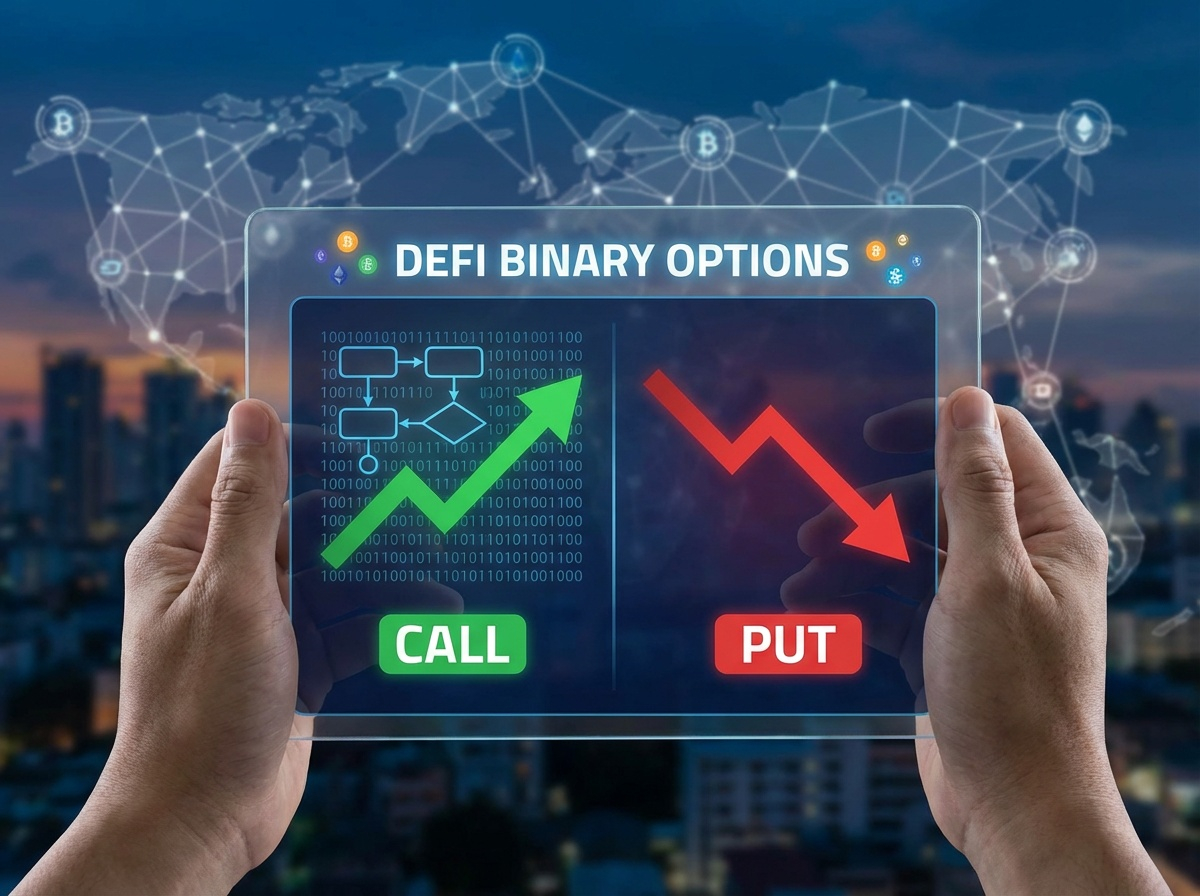
DeFi binary options are fixed-outcome contracts implemented on blockchains. Like traditional binary options, they pay a predetermined amount if a specified condition is true at expiry, and pay nothing if it is false (i.e. you lose your entire stake).
The crucial difference between traditional binary options and DeFi binaru options is that for the latter, the contract logic, collateral management, and settlement are handled by smart contracts on a public ledger and not by a central broker. In practice that means the rules are code, trading history is on-chain,
and settlement usually depends on an oracle feeding off-chain price data to the smart contract.
Under the hood, a DeFi binary option is usually a tokenised claim. You buy a token that represents the “yes” side of an event and another party holds the “no” side, or you buy from an automated market maker that prices those claims arithmetically. At expiry, the smart contract consults the oracle and distributes collateral according to the outcome.
Instead of a direct counterparty, users often trade against an automated market maker, such as an LMSR or similar bonding-curve models, that prices those claims mathematically. LMSR stands for Logarithmic Market Scoring Rule, and is a type of automated market maker (AMM) used in prediction markets and DeFi binary options to price and manage trades of outcome tokens.
Sometimes there is a direct human counterparty, but more frequently, your counterparty is a liquidity pool and not a specific trader. Liquidity providers typically earn money from trading fees and from the spread/ pricing edge.
Mechanics and typical flows
A trade begins with selecting an event and staking collateral. The event can for instance be simple price direction for a specific timestamp, a prediction market question, or a composite event that depends on several inputs. Collateral normally sits in the smart contract and is either provided by a central liquidity pool or by counterparty holdings. Pricing is derived either from user driven order books, from an AMM curve that maps probability to price, or from peer matched offers. Once you place a position you cannot usually change it, and the contract will enforce expiry and settlement automatically. The reliability of the final payout depends on the oracle architecture, the smart contract code, and the liquidity rules baked into the protocol.
Risk management
Some DeFi providers implement different ways to reduce some classic binary problems when it comes to risk management. Some allow early exit by selling your position back into the pool, others let you hedge with the opposing token, and a handful add mechanisms to limit manipulation around expiry.
Prediction markets and derivatives protocols
DeFi binary options appear in two main forms on Ethereum and other smart contract platforms. One is prediction markets, which operate like decentralised betting exchanges using pooled liquidity and on chain resolution. The other is derivatives protocols that offer short dated digital contracts on prices via Automated Market Makers (AMMs) or isolated pools. You can also find hybrid offerings that wrap centralized data feeds into smart contract settlement to offer binary style payoffs for non-crypto assets.
Access usually requires a crypto wallet, gas to transact, and a source of collateral token, most commonly stablecoins. Liquidity and market choice are still narrower than in mainstream derivatives venues, so tradable events and expiry windows may be limited compared to centralized brokers. If you’re looking for exposure to a non-crypto underlying asset, verify whether the protocol’s oracle has robust access to the required price source.
What assets and events are available?
As of 2026, the most common type of underlying asset are cryptocurrency exchange rates, on-chain metrics, and protocol specific events. Examples include whether the BTC/USD exchange rate will exceed a certain price at a given time, whether ETH supply will hit a certain threshold, or the outcome of governance votes.
Some prediction markets accept broader event types, including sports, governmental elections, and macro data releases, but those require specialized oracles and often carry higher manipulation risk.
What are on-chain metrics?
On-chain metrics (blockchain state variables) use blockchain data directly. They are quantitative metrics derived from on-chain activity and will be trustlessly observable at settlement. Examples of common on-chain metrics are Total Value Locked (TVL), gas usage, number of active addresses, and transaction count.
Examples:
Will Arbitrum TVL be above $3B at epoch end?
Will Ethereum daily gas used exceed 120B by Friday?
What are protocol-specific events (state transitions)?
Protocol-specific events are binary yes/no outcomes tied to smart contract or governance events, such as governance votes, contract upgrades, and emergency shutdowns. They are discrete events that either happen or don’t, and they are often deterministic from contract state.
In addition to speculation, protocol-specific binary options are used to hedge protocol risks.
Examples:
- Will Proposal #198 pass governance by block X?
- Will Protocol Y deploy v3 before August 1?
- Will this protocol’s insurance fund be triggered?
Can´t I speculate on stock prices, forex, etc?
Yes, you can, but the assortment of DeFi binary options based on equity, forex, commodity prices, etcetera is still pretty limited. Protocols need to connect to high quality, multi source oracles to offer speculation on these type of assets. Practical availability is limited, because those oracles must be reliably permissionless or trusted enough to satisfy the contract’s settlement rules. We can therefore expect the majority of liquid markets to remain crypto-native. There is room for a trailblazing platform to build credible, decentralised price feeds for traditional assets.
Common fees and hidden cost
Expect protocol fees (a percentage of stake or payout), AMM slippage, spread costs, and network gas costs. Oracle fees are sometimes paid by users. If you use wrapped tokens or bridges, conversion and bridge fees add to the cost. For short-expiry trades, gas can be a significant percentage of your stake on high-fee chains, and you need to account for this when planning small trades.
Technical, economic, and legal risks
DeFi binary options combine the risks of binary products with the particular hazards of blockchain finance. Examples of important risk categories to consider:
- Smart contract risk. Bugs in contract code can allow theft, incorrect settlement, or state corruption. Audits reduce but do not remove this risk. Complex settlement logic increases the probability of edge case failures.
- Oracle risk. If the contract depends on a single price feed, manipulation or outages can produce incorrect settlement. Multi source oracles and time weighted averages mitigate this but introduce latency and partial settlement complexity.
- Liquidity risk. Many DeFi binary pools are shallow. Large positions can move the price dramatically and early exits may be expensive or impossible at times of stress.
- Design and economic edge. Many binary-like markets have a built in house edge through spreads, payout curves or impermanent loss for liquidity providers. Even where the market is permissionless, expectation math usually favors the protocol or the LP unless you have a demonstrable statistical edge.
- Front running and MEV. Because trades are public before execution, miners and validators can reorder or sandwich transactions to extract value. That can distort fills and settlement for time sensitive binaries.
- Regulatory and legal risk. Involving both retail-accessable binary options and blockchain solutions, DeFi binary options operates in a gray and complex regulatory spaces. Selling binary options to retail clients (non-professional traders) is banned or heavily restricted in many jurisdictions, and this raises the risk that services will be blocked, delisted by custodial on-ramps, or targeted by enforcement actions in such countries. Using DeFi does not eliminate this type of legal risk.
- Operational and counterparty risk. While decentralised protocols can reduce counterparty default risk, liquidity providers and front ends remain points of failure. UI bugs, withdrawal freezes on connected bridges, or third party oracle outages can also prevent you from accessing funds or settling positions cleanly.
How DeFi binary options compare with traditional retail binary options
For many, the appeal of DeFi binary options is largely transparency: trades and collateral on chain, immutable code, and public history. With on chain contracts you can inspect formulas, see real time liquidity, and trace settlement flows. Conventional retail binary options platforms have been criticized for their lack of transparency, especially considering the conflict of interest that comes from having the platform being both your broker and your counterparty in each trade. Conventional retail binary options platforms are typically based in offshore locations with lax trader protection rules, where they are not forced to be transparent, and where they are not strictly supervised by any financial authority that ensures the fair treatment of traders. Unsurprisingly, many users of offshore brokers are reporting problems with withheld withdrawals, opaque terms and conditions, and manipulated price feeds.
Since the conventional retail binary options industry is known to include quite a lot of fraudsters and sketchy platforms based in lax offshore locations, the transparency of the DeFi binary option can feel like a breath of fresh air. It is important, however, to remember that transparency is not automatically the same as safety. A DeFi contract can contain exploitable bugs, and public transaction data makes sophisticated attacks easier.
Regulatory recourse vary significantly depending on which route you decide to go. With a properly regulated broker supervised by a powerful financial authority in a country with strong trader protection rules, dispute resolution will be accessible, and issues can be escalated in a meaningful way. With offshore brokers in lax jurisdictions, recourse is much more limited. With DeFi binary options, the legal situation will be gray and complex, and proving wrongdoing and obtaining remediation in DeFi is still both technically and legally difficult.
Offshore brokers in lax jurisdiction are associated with practices that disadvantage clients, like price feed manipulation, unreasonable account freezes, and opaque bonus rules. DeFi protocols can eliminate some of those practices through code, but they introduce new failure modes. In short, DeFi removes certain counterparty risks while adding technical and oracle risks. Neither environment is risk free; they are just different risk portfolios.
Practical due diligence and safer practices
If you consider trading DeFi binary options, treat the activity as speculative and apply a strict due diligence routine. Check whether the smart contracts have public audits and whether the audit firms are reputable. Inspect the oracle design: multi source, decentralised aggregation, and time weighting are preferable. Evaluate liquidity depth and historical volume. Test small deposits and small trades, and confirm withdrawal paths work through any bridges or wrapped token flows you need to use. Use wallets with hardware key protection and enable transaction review tools to detect suspicious behavior. Consider whether insurance pools exist for the protocol and read the fine print. Many “coverage” schemes have narrow triggers and limited capital.
Just as with other types of speculative trading, risk sizing rules are essential. Binary payoffs are all or nothing, and small stakes and conservative bankroll rules need to be in place to reduce the chance of rapid ruin. Limit the capital you allocate, set session loss caps, and weekly caps. Do not adhere to any strategy that involves doubling down after a loss.
Make sure you understand the legal framework for both DeFi and binary options in your jurisdiction before you proceed.
Examples of use cases
While many traders begin with short-term speculation, the programmability of on-chain contracts enables a wider range of strategies that extend beyond simple “higher or lower” bets.
- Short-term speculation and event-driven trading remain the most straightforward applications. DeFi binary options allow traders to express views on near-term price movements or specific outcomes tied to real-world events, such as macroeconomic announcements or elections. Platforms like Polymarket further blur the boundary between trading and prediction markets by offering binary-style contracts on topics that span crypto assets, financial events, and even sports outcomes.
- Another common approach is hedging volatility with on-chain options. Crypto markets can move sharply, especially around major announcements, and some traders use DeFi binary options as a fast, tactical hedge. For instance, a trader holding Bitcoin who anticipates heightened volatility may open a short-term downside position to partially offset potential losses during turbulent periods.
- A less common type of use case involves yield generation and liquidity incentives. DeFi options platforms are typically supported by liquidity pools, and participants who stake assets into these pools may earn a portion of trading fees or protocol-issued token rewards. Returns can vary significantly, ranging from relatively modest yields to more attractive levels depending on market conditions. Note: If traders collectively profit against the pool, liquidity providers absorb the losses.
DeFi Binary Options History and Development
The development of DeFi binary options illustrates a steady evolution from theoretical constructs to functional on-chain products. Beginning with Ethereum-based prediction markets in the mid-2010s, the field has grown through experimentation with liquidity pools, oracle integration, and protocol-specific innovations. Dedicated platforms emerged in 2020–2021, bringing short-term crypto derivatives fully onto decentralized networks. Along the way, the acknowledgment of risks associated with MEV, thin liquidity, and oracle vulnerabilities have driven improvements in contract design.
Early Roots: Prediction Markets
The conceptual foundations of DeFi binary options can be traced backed to the early decentralized prediction markets. One early trailblazer was Augur, which launched on Ethereum in 2018 after several years of development, enabling users to create and trade markets with binary outcomes. For instance, users could wager on whether a specific cryptocurrency would reach a particular price by a certain date or whether a political event would occur. Although Augur and similar platforms such as Gnosis were framed as prediction markets rather than explicit financial derivatives, economically they mirrored binary options. Traders assumed positions that paid out fully if an event occurred and traders would lose their entire stake if the event did not occur. These early systems demonstrated that smart contracts and decentralized oracles could resolve binary outcomes automatically.
Despite their innovation, early on-chain prediction markets had notable limitations. Transaction costs on Ethereum were high, especially during network congestion, and market liquidity was often thin. The user experience was complex, as traders needed to understand market creation, tokens staking, and oracle resolution mechanisms. These constraints limited mainstream adoption. Still, the early prediction markets established critical proof of concept, paving the way for more sophisticated financial products. Evidently, smart contracts could enforce the settlement of binary outcomes reliably.
2019-2020: Increased sophistication
The next major evolution occurred around 2019–2020, as the broader DeFi ecosystem began to mature. The rise of automated market makers (AMMs), liquidity pools, and composable smart contracts enabled a shift from peer-to-peer prediction markets to pool-based binary options and short-dated derivatives. Instead of relying on individual counterparty matching, traders could now interact with a pool of liquidity that automatically quoted prices and paid out on settlement. This innovation aligned closely with traditional binary options mechanics.
During this period, developers experimented with various ways to make on-chain binary options more accessible, reliable, and responsive to fast-moving markets. Protocols began integrating oracles for real-time pricing, enabling contracts to settle based on accurate market data. Smart contract design evolved to include expiration windows, automated payouts, and risk management parameters, reflecting lessons learned from both early prediction markets and traditional finance. These innovations reduced friction for traders and increased confidence that contracts would settle fairly and efficiently.
2020-2021: Dedicated DeFi Binary Options Protocols
By 2020–2021, dedicated DeFi binary options platforms began to appear, representing a clear evolution from the experimental phase. Projects such as Thales, Hegic, and PRDT Finance offered explicit “up/down” or “in/out” contracts on crypto assets, combining the predictability of binary outcomes with DeFi’s advantages, especially decentralization, composability, and transparency. These platforms were designed to handle short-term speculation, hedging, and event-driven trading, and they often featured automated settlement and oracle-based pricing to reduce operational risk.
Thales, for example, allowed users to take positions on the direction of cryptocurrency prices at a specified expiry. Hegic experimented with options pools and algorithmic pricing mechanisms, while PRDT Finance expanded binary options across multiple chains, including Binance Smart Chain and Polygon.
At the same time, Augur and other prediction-market protocols continued to evolve, increasingly incorporating financial use cases beyond political or social outcomes. This period marked the formal convergence of DeFi and binary options, creating products that were functionally similar to their traditional counterparts but fully decentralized.
2022 and Beyond: Enhancements and Risk Mitigation
As DeFi binary options matured, developers and researchers increasingly addressed the structural risks inherent in short-term, on-chain derivatives. Two key areas of innovation were oracle design and blockchain-specific risks. Price oracles became more robust, moving from single-point feeds to aggregated sources and time-weighted averages to prevent manipulation by capitalized traders. Similarly, the community became more aware of Maximal Extractable Value (MEV) risks, where validators or bots could profit by reordering, front-running, or sandwiching transactions in a block. These insights influenced contract design, leading to delayed settlement windows, slippage limits, and other mechanisms aimed at mitigating exploit opportunities.
Liquidity considerations also shaped development. Early DeFi binary options often suffered from thin liquidity, which created large spreads and increased vulnerability to manipulation. Over time, protocols incorporated liquidity incentives and yield farming mechanics, encouraging users to stake assets in option pools. This not only improved execution quality but also created an intersection between trading and passive income strategies. However, protocol designers had to balance incentives carefully, as concentrated liquidity in short-term contracts can still be exploited if market participants collude or if MEV behaviors dominate settlement timing.
Current Landscape
Today, DeFi binary options remain a niche but evolving segment of the decentralized finance ecosystem. Platforms like Thales, Injective, PRDT Finance, and Hegic offer a variety of contracts with different expiries, underlying assets, and settlement mechanisms. Meanwhile, prediction market platforms such as Augur continue to blur the lines between event speculation and financial derivatives. The history of DeFi binary options reflects a broader trend in decentralized finance: the gradual translation of traditional financial instruments into programmable, trustless smart contracts.
While adoption remains limited compared to perpetual futures, spot trading, or lending protocols, DeFi binary options have demonstrated the potential for innovative risk management and speculative strategies in a fully decentralized context. They also highlight the ongoing need for careful design around oracle reliability, liquidity depth, MEV protection, and user education. As developers continue to refine protocols and integrate lessons from early markets, the next generation of DeFi binary options may become faster, more secure, and more accessible, even if regulation and user caution continue to shape adoption.
FAQ for DeFi Binary Options
What are DeFi binary options?
DeFi binary options are fixed-outcome contracts written in smart contracts on a blockchain. The contract defines a yes/no question tied to an observable event (for example “will ETH/USD be above $3,000 at 12:00 UTC?”). Traders stake collateral into the contract or buy outcome tokens. At expiry, the contract consults an oracle and automatically distributes the collateral to winning holders while losers get nothing. Functionally, they mirror traditional binary options in payoff structure, but settlement, collateral handling, and record keeping are on-chain.
How is a DeFi binary option executed and settled?
Execution typically happens in one of three ways: peer-to-peer matching, an on-chain order book, or an automated market maker (AMM) that prices the yes/no tokens. Once you place a position it is encoded in the contract state. At expiry the smart contract reads a price or an event result from an oracle and executes the settlement rules in code — moving funds from the pool to winning addresses. Settlement is automatic and auditable on the ledger, but it relies entirely on the oracle and the correctness of the smart contract.
What role do oracles play, and why do they matter?
Oracles provide the off-chain price or event data the smart contract needs to decide outcomes. The oracle design (single source vs multi-source, time-weighted average vs instantaneous price, decentralised vs trusted provider) determines the settlement reliability and the vulnerability to manipulation. A weak or single-point oracle can be spoofed or suffer outages, producing incorrect settlements. Stronger designs use multiple feeds and aggregation logic to make manipulation and downtime more difficult.
What assets or events can you trade with DeFi binary options?
Most liquid DeFi binary markets centre on crypto native underlyings and on-chain metrics. Common examples include price levels for BTC, ETH, major tokens, liquidity pool metrics, or protocol governance outcomes. Some platforms extend to traditional assets (stocks, FX, commodities) via reliable off-chain oracles, but those markets are less common. Expect the most consistent liquidity and variety in crypto native markets.
Where can I trade DeFi binary options?
You trade them on blockchain-based platforms and prediction market contracts deployed on smart contract chains. (Ethereum and compatible L2s are common.) Access requires a compatible wallet, native token or stablecoin for collateral, and often gas to submit transactions. Liquidity and market variety differ by protocol. Some decentralised derivatives protocols host binary products as part of a broader derivatives suite, while dedicated prediction market projects focus on event options.
Can you close or exit a position before expiry?
That depends on protocol design. Some systems allow early exit by selling your outcome token back into an AMM or to another counterparty, which lets you lock a partial profit or cut a loss. Others are strictly fixed-expiry, which means that once you buy, you must await settlement.
Early exit capability improves risk control but requires liquidity in the secondary market, something many small pools lack.
What are the main technical risks?
Smart contract bugs, incomplete audits, and complex settlement logic are primary technical risks. Even audited contracts can contain exploitable edge cases. Bridge and wrapper contracts used to move collateral between chains introduce additional attack surface. Users face the risk of fund loss due to logic errors, reentrancy, incorrect event handling, or admin keys that can be misused. Code visibility helps (you can read contracts on-chain) but understanding subtle vulnerabilities can be difficult for inexperienced users.
What about oracle and market-manipulation risks?
Oracles that depend on point-in-time price snapshots or thin liquidity sources are vulnerable to influence by well-capitalized traders. At the same time, MEV behaviors (such as validator reordering, front-running, and sandwich attacks) can skew price observations and affect execution around sensitive settlement windows. While designs that incorporate time-weighted pricing, multiple data sources, and enforced delays help mitigate these issues, they cannot fully remove them. In practice, manipulation risk increases as liquidity becomes more concentrated and contract expiries become shorter.
Note: MEV (Maximal Extractable Value) is the additional profit that can be captured by controlling or exploiting transaction ordering, inclusion, or timing within a block on a blockchain.
It arises because transactions are public before confirmation (via the mempool), executed in a specific order, and financially sensitive (DEX trades, liquidations, oracle updates, expiries).
What is a mempool?
A mempool (short for memory pool) is the place where a blockchain node keeps valid transactions that have been submitted but not yet confirmed in a block. Nodes broadcast transactions to the mempool, where they wait to be picked up by miners or validators, usually prioritized by gas fees or network rules. For DeFi binary options and other smart contract-based derivatives, this queuing process is crucial because transaction ordering can directly impact payoffs.
MEV (Miner/Maximal Extractable Value) refers to profits that miners or validators can extract by strategically reordering, including, or censoring transactions in a block. Common MEV behaviors include front-running (inserting one’s transaction ahead of a profitable one), sandwich attacks (placing transactions immediately before and after a target to exploit price changes), and general transaction reordering. For short-term options or event-driven contracts, MEV can significantly affect outcomes. A front-run on an options trade could alter the underlying price just before settlement, while sandwich attacks could inflate slippage, reducing expected payoffs. Consequently, traders face additional execution risk beyond market volatility, highlighting the importance of mempool transparency, gas optimization, and MEV-aware strategies when trading time-sensitive DeFi derivatives.
How does liquidity affect trading and pricing?
Just as with traditional financial trading, liquidity determines how easily you can enter, exit or hedge positions without moving the market. Shallow pools produce wide bid/ask spreads and significant price impact for modest-sized trades. AMM-priced binaries embed a curve that shifts as trades occur, which means large trades change the implied probability and cost dramatically. Thin liquidity also raises the chance of being unable to exit early when you want to. Always check pool depth and historical volume before sizing a trade.
Is insurance or protection available for DeFi binary options trading?
For DeFi binary options, insurance or loss protection is not automatically provided. Some protocols maintain internal insurance pools or integrate with third-party coverage providers, but these protections are typically narrow and limited in scope. They are often subject to the protocol’s own capital constraints and narrow claim triggers. Insurance terms are frequently technical and highly conditional, with strict definitions, claim requirements, and approval processes. Relying on implicit promises of coverage is not a good idea. Assume you are responsible for all losses unless explicit, well-capitalised protection is documented.
Coverage, when available, often applies only to very specific events, such as certain smart contract failures, and excludes common risks like pricing errors, MEV effects, or oracle issues. When insurance is constrained by the size of the available capital, payouts can be partial or unavailable if losses are large or widespread.
How should I size positions and manage risk specifically for DeFi binaries?
Treat them as speculative, high-variance bets. Position sizes should be small relative to total capital, with session, daily, and weekly loss caps enforced. Because outcomes are binary and streaks of losses are probable, use conservative per-trade percentages and strict stop-loss equivalents (session caps or maximum consecutive losses) rather than relying on exit orders. Account for gas and slippage costs in sizing calculations. If you cannot accept the possibility of rapid, total loss of your stake, do not participate.
How do tax and record keeping work?
Blockchains provide transaction history, but tax rules vary by country, answering this question is not possible without knowing the applicable jurisdiction. Generally speaking, DeFi settlements produce taxable events and you need to track realized gains/losses, timestamps, and local currency equivalent at time of event. Many jurisdictions require reporting of crypto income as capital gains. Keep detailed records and consult a tax professional familiar with crypto for compliance.
Examples of DeFi protocols and platforms that support binary options on-chain:
- InjectiveThis is a a blockchain ecosystem with native support for DeFi binary options markets, allowing developers to build or trade binary-style outcomes using smart contracts and decentralized infrastructure.
- Thales ProtocolThis is a decentralized protocol specifically designed for binary options trading on Ethereum, enabling users to create and trade markets where outcomes resolve to yes or no.
- BinaryX
This protocol focus on sports, political, or other event-based binary outcomes, integrating real-time data feeds for resolution. - Augur (prediction markets)
While primarily a prediction market platform rather than a pure binary options platform, Augur lets users create and trade event outcomes that function very similarly to binary options contracts.