
Risk Management for Swing Trading



Unlike day trading, swing trading is not fast enough to escape overnight exposure, and unlike position trading and longer term investing, it is not slow enough to ignore certain types of short-term market noise. A swing trader typically holds a position for several days to several weeks, trying to capture a measured move rather than every tick. That holding period have a big impact on how we need to think about risk.
Regrettably, many inexperienced traders who are just starting out treat risk management as a defensive extra, something added after they find a setup they like. A much better approach is to realize that proper risk management is the structure holding the entire trading project together.
Risk management is mainly about controlling the cost of being wrong. Even strong setups fail. A breakout can reverse, a trend can stall, and a clean earnings gap can fade. The trader who lasts is not the one who believe they will predict every move well. It is the one who understands that incorrect predictions will happen and keeps losses small enough that a run of failed trades does not damage the account beyond repair. That is why risk management for swing trading begins long before the order is placed. The trader needs to know how much capital is at risk, where the trade is invalidated, what size is appropriate, and which kinds of events that are most likely to change the outcome.
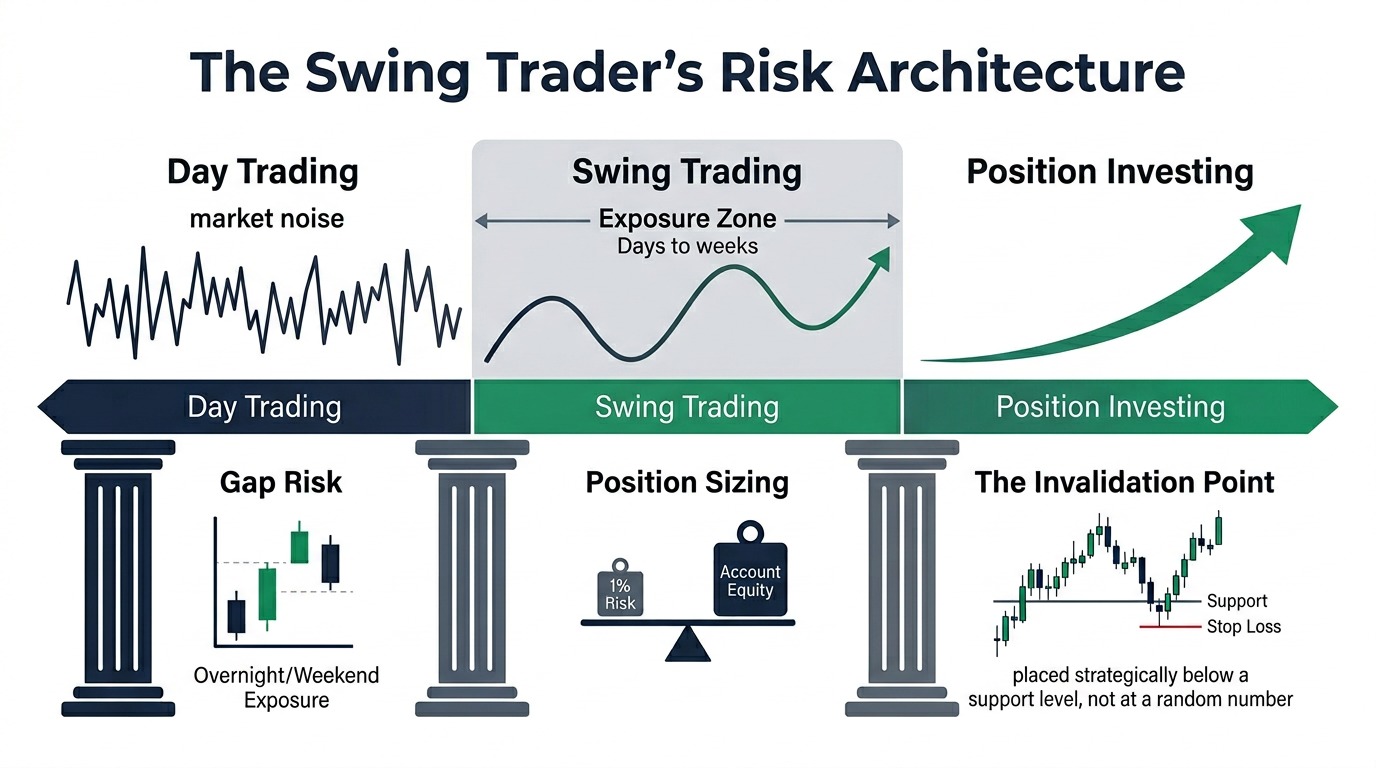
The Risk Profile For Swing Trading
Swing trading carries risks that are different from both day trading and long-term investing. Below, we will take a look at a few examples of important points that need to be taken into consideration as you develop your risk management routine.
A day trader will close positions before the trading day closes and avoid overnight surprises. A position trader or longer-term investor has a long enough time-horizon to tolerate a lot of smaller trends. The swing trader sits in between, holding a comparatively tight position through company news, macro data releases, central bank comments, shifts in market sentiment, and more. ‘
Gap risk matters more for swing traders than many beginners expect. A stock can close at one level and open materially lower the next day after earnings, guidance, regulatory headlines, or sector news. An index can gap after inflation data or a rate decision. In forex, markets reopen after weekends with price gaps when geopolitical events or policy developments emerge outside liquid hours. This means the stop loss order is not a guarantee of exact execution. It is an instruction to exit when price reaches a level, but in a fast or gapped market the fill may be worse than planned. For skilled swing traders, this is a normal part of the game, not an exception, and their risk management routines will reflect that.
There is also the issue of accumulated uncertainty. A position held for five or ten trading sessions passes through more market conditions than a trade lasting twenty minutes. That longer exposure gives the setup more room to work, but it also gives the market more opportunities to do something unhelpful. Risk management in swing trading therefore has to absorb this.
Position Sizing: The Core of Risk Control
Risk Per Trade
The most important decision in swing trading is often not exactly where to enter but how much to buy or sell. Risk per trade should be set as a small fraction of total account equity. Many traders cap their risk at 1% per individual position. Some use half a percent when the market is unstable or when they are trading several positions at once. The exact figure can vary, but the principle stays the same: no single trade should be large enough to cause serious account damage, and your account should be able to handle a string of losses without collapsing.
The 1% cap sounds overly conservative until a losing streak appears. Swing trading can produce strings of losses even for strong traders, especially when conditions turn choppy or when breakouts keep failing. If each loss is modest, the account stays stable enough to continue. If each trade risks too much, a normal bad stretch turns into a structural problem. The main purpose of fixed risk per trade is survival. The cap protects the account from emotional oversizing and keeps losses mathematically manageable.
Portfolio Risk and Correlation
Single-trade risk is only part of swing trading. Portfolio risk matters as well.
Sometimes, very inexperienced traders think that opening three almost identical positions where each is below 1% of the account balance is sufficient risk management, and believe they are actually sticking to the 1% rule this way. Of course, most traders understand that “tricking” your own rule book in this fashion is just hurting yourself.
While this type of mistake is easy to spot for most of us, other types of correlation can be more difficult to see unless you are paying attention. Buying three semiconductor stocks, a tech-heavy ETF, and a broad market breakout at the same time may look like five trades. In reality, it may be one large bet on the same market factor. Risking less than one percent on each position can still mean you are taking far more exposure than intended when the trades are highly correlated.
This can feel abstract while everything is running along smoothly, but the problem with correlation often becomes painfully obvious when the market turns. Correlated positions often lose together, and what looked like a well-diversified book starts behaving like one oversized trade spread across multiple charts. A commonly seen situation in forex is when a trader is long several dollar pairs that amount to repeated exposure to the same underlying theme.
Swing traders therefore need to think at two levels. The first is the risk on each trade. The second is the risk across the whole book if related positions move against you together. There are several ways to deal with this, and you need to tailor it to your trading plan and risk willingness. You might for instance need to both cap total open risk at a fixed percentage of equity, while also sticking to rules about how to keep position size extra small when several positions depend on the same sector, theme, currency factor, etcetera.
Correlation is easy to ignore when markets are trending smoothly because all the positions look smart together. It becomes expensive when the common driver reverses and everything drops at once. Good swing traders treat clustered exposure as real concentration, even if the risk is spread out over many different positions.
The Relationship Between Stop Distance and Share or Lot Size
Skilled swing traders understand that there is a connection between share or lot size and where you decide to place your stop loss point. Position size should come from the stop distance, not from how strongly the trader feels about the setup. The calculation is simple in concept. First decide how much account capital can be lost if the trade fails. Then define the stop level based on market structure. The difference between entry and stop tells you how much risk exists per share, contract, or lot. From there, the correct size follows.
Example: If a trader has a $20,000 account and chooses to risk one percent, the maximum planned loss is $200. If the setup requires a stop $4 away from entry, the trader can take 50 shares. If the stop needs to be $2 away, the position can be 100 shares. Wider stop, smaller size. Tighter stop, larger size. The money at risk stays the same, if we assume that the market is liquid enough for the stop loss to be executed without slippage.
Do not do this backwards. Many inexperienced swing traders go through the process in reverse, and that is not something we recommend. They decide first that they want 500 shares, then try to make the chart justify that size. That method usually ends badly. In swing trading, the chart defines the stop, and the stop defines the size.
Why Large Positions Break Good Setups
Even a good setup becomes fragile when the size is too large. Oversized positions can easily distort judgment and make you obsessive. You begin to watch profit and loss instead of market structure. A normal pullback now feels catastrophic and a small gap against the position feels intolerable. The result is usually early exits, stop movement, or refusal to take the next signal because the previous one hurt too much.
Large positions also make it harder to hold through planned volatility. Swing trades need room. If the size is too big, the trader often cannot tolerate the very movement the trade requires in order to work. You need to be able to handle the SWING in swing trading, even if you are following a trend-based strategy. When a position is to big, traders become more likely to exit before the move develops or, worse, widen the stop to avoid taking a loss they should have accepted.
The market does not care that the setup was high quality. If the position was too large for the trader’s account and psychology, the trade was poorly managed from the start.
Using Stop Losses in Swing Trading
Technical Stops vs Arbitrary Stops
A stop loss should sit at the point where the trade idea is no longer valid, not at a random round number that happens to feel comfortable. In most situations, skilled swing traders relying on technical analysis will place the stop beyond a technical level with actual meaning. It might be below a recent swing low in an uptrend, above a swing high in a short setup, or beyond a support or resistance level that defines the trade structure. The stop is there to mark invalidation, not simply to limit discomfort.
Arbitrary stops cause two main problems for swing traders. They are often too tight for the instrument’s normal movement and they do not reflect the logic of the trade. When price hits them, the trader learns nothing except that the market moved. A technically placed stop, by contrast, tells the trader something useful. If that level fails, the original setup likely changed or broke. That does not mean every technical stop is perfect. It means the stop should be based on market structure rather than on personal preference alone.
Volatility Matters
Swing traders need to respect volatility because holding over multiple sessions exposes the trade to wider price movement than intraday systems typically face. A stock that is expected to move three percent per day needs a different stop treatment from one that is expected to move half a percent. A forex pair around major macro events behaves differently from the same pair in quiet periods. The stop has to reflect this background movement. If it is too tight relative to typical volatility, the trader gets shaken out of valid trades. If it is too wide without position size adjustment, the dollar risk becomes excessive. This is why tools like average true range can be useful. They do not decide the trade on their own, but they help the trader see whether the stop is realistic relative to the instrument’s normal range. Swing trading without any volatility awareness tends to produce one of two outcomes: repeated stop-outs from noise or losses that are too large when the trade fails cleanly. The stop must fit both the chart and the volatility environment.
The Problem With Manually Expanding Stops
Moving a stop further away after entering a swing trade is one of the fastest ways to corrupt a risk management plan. The usual justification is familiar. The trader says the market is only “testing support” or that they need to “give it a bit more room.” Sometimes that is true in a descriptive sense. The real problem is procedural. The original risk was calculated from the first stop location. Once the stop is widened, the trade risks more than the trader approved at entry. That change often happens under emotional pressure rather than clear analysis. The loss looks close, so the trader buys time by expanding it. Occasionally the trade recovers, which encourages the habit. Over time, though, this behavior destroys consistency. The trader no longer knows what one unit of risk means because losses are elastic.
There are valid ways to tighten stops as a trade develops. Expanding them after entry is much harder to justify. In most cases it is a disguised refusal to accept that the trade failed.
Trailing stops and swing trading
A trailing stop is a type of stop-loss order that automatically adjusts as the price of a security moves in your favor. Unlike a fixed stop-loss, which stays at a set price, a trailing stop “trails” the price, either by a fixed amount or by a percentage.
For long positions, the trailing stop will move up as the price increases. It will not move down even if the price moves down. Example: You buy a stock at $100 and set a 10% trailing stop. If the stock rises to $120, your trailing stop adjusts to $108 (10% below $120). If the stock then falls to $108, the stop triggers a sell order, locking in a $8 profit.
Trailing stops can very very useful for swing traders, since swing traders typically hold positions for days to weeks, trying to capture short- to medium-term trends. Trailing stops allow them to lock in profits as the trend moves in their favor, and automatically manage the stop-loss without monitoring the market constantly and increase the risk of emotional decision making. A trailing stop-loss can help the trader to ride trends longer than a fixed stop-loss might allow, which is key for maximizing swing trades.
Exactly how trailing stops are used depends on the trading strategy, and also on what the trading platform supports. Percentage based trailing stops, like in the example above, are often set to 5–10% below the peak price. A more complex method is to use an ATR-based trailing stop, where the Average True Range (ATR) is utilized to set a stop distance that adapts well to market volatility.
Even though trailing stop-loss orders can very helpful for swing traders, they do come with their own challenges and limitations, which are important to account for. In volatile markets, a trailing stop can trigger on short-term price swings, closing the position automatically even though conditions show that the main trend is very likely to continue soon. Automated trailing stops are precise, but manual adjustments let you account for context, e.g. news events. As with all stop-loss orders, it is also important to remember that immediate execution is not guaranteed. Overnight gaps, fast-moving markets, or a lack of liquidity can cause the exit price to differ from the stop price (slippage).
In summary, trailing stop-loss orders can be a powerful tool for swing traders because they allow profits to run while limiting losses, but they need to be used with care. The biggest challenge is setting the “right” distance to avoid being stopped out prematurely or letting the price drop too far below the peak before the position is closed.
Take-Profit Orders and Swing Trading
A take-profit (TP) order is an order to automatically sell (if the position is long) or buy (to cover for shorts) when the price reaches a specific point. Unlike a stop-loss, which limits losses, a take-profit locks in gains when the market moves in your favor. Instead of having to close the position manually, it will happen automatically.
Example: You buy a stock at $100. You set a take-profit at $120. If the price reaches $120, a sell order is generated automatically, securing a $20 profit (unless there is slippage).
Take-profit orders can help swing traders manage risk and performance by locking in profits automatically. When positions need to be closed manually, there is always an increased risk of being influenced by emotions in the heat of the moment. Greed can make you keep the position open longer than planned, while fear can make your close it prematurely.
When a take-profit order is combined with a stop-loss order, you have predefined the trades potential max profit and potential max loss. You define the trade´s reward vs. risk in advance, in accordance with your trading strategy, and this provides better clarity. The take-profit order forces you to set a goal in advance, instead of going with a “let´s see what happens”.
Unlike many day traders, a swing traders is not glued to the screen continuously when there is a position open. Setting not only stop-loss orders but also take-profit orders immediately when a position is opened provides emotion-free exists and reduces the temptation to spend too much time starring at, and obsessing about, price movements.
So, where to swing traders typically place their take profit orders? Swing traders that rely on technical analysis will often place a take-profit order near a resistance level for long positions. More advanced strategies can use measured moves from patterns like flags, triangles, or head-and-shoulders to determine where to put the TP-order. You can also decide the TP-point based on desired reward relative to stop-loss, e.g., 2:1 or 3:1.
Of course, sticking to a take-profit order can feel painful when the market trend keeps on trucking. One way to combat this is the trailing take-profit order. But even with a trailing take-profit, you still need to define certain parameters. And both conventional and trailing take-profit orders are sensitive to slippage. They can only generate a sell order, not guarantee that your position will actually be closed at exactly that price, and this must be taken into account in the overall risk management process.
If you decide to use a trailing take-profit order, remember that it can trigger on minor pullbacks in volatile markets. As always, you need to find the right balance between strictness and wideness.
Example of how a trailing take-profit can be used: You buy at $100 and set a TP-order to start at $120 and move to 5% below peak price. The price rises to $140 and your TP-order moves to $133, since that is 5% below $140. The price drops to $133 and a sell order is generated automatically. With a fixed TP-order at $120, your profit would have been $20. With the trailing TP-order, you profit is instead $33.
Managing Overnight, Weekend, and Event Risk in Swing Trading
Because swing trading involves holding positions beyond a single session, overnight and event risk must be addressed, and weekend exposure deserves separate attention. Markets can close for the night or the weekend, but political events, conflict, regulatory announcements, and commodity developments can still happen. When the market reopens, price may be materially different from the close. That is part of swing trading reality.
Earnings are a clear example of scheduled event risk in equities, as a technically clean setup can be overwhelmed by a report released after the close. Guidance, margins, revenue misses, legal developments, and even the so-called “conference call tone” can cause a gap large enough to bypass the stop entirely. Conference call tone refers to the overall attitude, confidence, and messaging style that company executives convey during an earnings call, usually in the Q&A and prepared remarks after results are released. Even if the numbers look fine on paper, how management talks about the business can strongly influence how traders react. For a swing trader, holding through earnings should be a deliberate decision rather than a default one. Some only hold if the position already has enough cushion to absorb the risk. Some reduce size sharply before the announcement, and some exit completely.
Macro events create a similar problem in markets such as indices, bonds, and currencies. Inflation data, employment reports, central bank meetings, and policy comments can change price levels quickly. A trader carrying a position into such events needs to know that the trade is no longer just about the chart, it is now exposed to scheduled information risk.
The practical response is not to avoid all risk. It is to take both overnight, weekend, and event risk into account and risk manage accordingly. In addition to juggling the risk of non-schedule events that may impact overnight and over-weekend holdings, you also need to stay on top of the relevant scheduled events and understand when ordinary chart risk becomes event risk. A trade held through a quiet week is not the same trade when a major decision or report is pending.
Risk to Reward, Expectancy, and Trade Selection
Swing traders do not need an extremely high win rate to succeed, but they need to understand positive expectancy. Expectancy comes from the relationship between average win size, average loss size, and win frequency. A trader who wins only 45 percent of the time can still be profitable if winning trades are materially larger than losing ones. A trader who wins 70 percent of the time can be unprofitable if losses are allowed to grow while gains are taken too quickly. This is why risk to reward matters so much in swing trading. The holding period usually gives the trade room to produce a move larger than the initial stop distance. That potential is part of the edge. If the trader repeatedly takes small gains out of fear while leaving full losses untouched, the math deteriorates fast.
Trade selection connects directly to this. Not every pattern is worth the risk. A setup that offers little upside before running into resistance, or one that requires a very wide stop for modest reward, may simply not justify the capital. Swing traders need to ask whether the probable reward is large enough relative to the defined risk before entering. Inexperienced swing traders are more likely to get obsessed with entries and indicators, and forget about other important things, including how proper risk management is about more than just reducing loss size. Among other things, you risk management routines should help you reserve risk for setups where the expected payoff justifies the exposure. Traders who take mediocre trades with disciplined sizing still waste capital and attention. Swing trading improves when the trader becomes sufficiently selective about where risk is deployed.
The Psychological Side of Risk Management for Swing Traders
Most risk plans fail not because they are poorly designed, but because they are not followed. This is true for many different trading styles, and it is also important to remember that a trader moving from day trading to swing trading or vice versa can suddenly find themselves struggling to stay with the program, even though they were highly disciplined before the switch.
If you are used to day trading or position trading, you might find that swing trading tests you patience and discipline in its own particular ways. The trade takes longer to develop than an intraday position, but it still produces daily fluctuations large enough to provoke emotional reactions. One trader sees unrealized profit, worries it will disappear, and exits early. Another sees a planned loss approaching, hopes for a reversal, and delays the exit. Hope and fear might not be as dramatic here as for day trading, but they have a tendency to become repetitive and can wreck an otherwise good trading plan.
Boredom matters and should not be underestimated. Because swing traders do not need to act constantly, many force trades when nothing is setting up cleanly, especially if they come from a highly active day trading style. Impatience and boredom then gets dressed up as market participation and “working hard”, and this bad habit creates exposure where none was needed.
There is also ego. Traders often increase size after a run of wins because confidence drifts into overconfidence. Or they revenge trade after a stopped-out position because their ego was bruised and feel the market “owes” them. Risk management rules are there to prevent sudden emotions from turning into actions, but the rules will only work if the trader actually respects them when emotions rise.
The psychological side of swing trading is less frantic than day trading, but not easier. It simply works on a slower clock and come with its own peculiar challenges. A trader may break the plan one small decision at a time, e.g. by entering slightly early, reducing the stop discipline, adding to a weak trade, and refusing to cut a position before a risky event. None of these actions feels dramatic in the moment. They will actually feel clever, as if they are something you do because you are working hard and paying attention to the market, refusing to leave your open positions unmanaged like a more lazy trader might. Regrettably, this type of thinking often lead swing traders astray, especially when they are inexperienced. Together, all the small and “clever” changes to the original plan can undo the entire framework and dig deep holes in your account balance.
Building a Repeatable Risk Process
Risk management for swing trading needs to be built on plans and routines rather than be reactive. A repeatable process begins with things such as fixed rules around risk per trade, technically sound stop placement, and position sizing that follows from the stop. It extends to portfolio awareness, so several related positions are not mistaken for diversification, and it also includes awareness of event risk, because a holding period of days or weeks means exposure to information shocks is part of the strategy, not an exception. The trader who improves over time usually stops thinking of risk management as damage control, and instead let it become part of trade selection itself. If the stop does not make sense, the trade is skipped. If the size required is too small to be worthwhile or too large to be safe, the trade is skipped. If correlation is too high or an event is too close, the trade is reduced or avoided. That mindset sounds restrictive, but it is what keeps swing traders in the game long enough for good setups to matter. The goal is not to avoid all losses. The goal is to keep losses ordinary, repeatable, and survivable. In swing trading, that is what makes the rest of the method possible.