
Best Trading Journals For Swing Trading 2026



Swing trading is all about holding trades for days or weeks, not minutes. That makes record-keeping even more important.
If you don’t track your trades, it’s easy to forget why you entered, what you saw in the chart, or how you felt at the time.
Our expert traders have highlighted the key factors to consider when selecting the best trading journals for swing trading.
What Is A Trading Journal?
A trading journal is a record of your trades. It’s more than just a list of entries and exits. It’s a place to track the setup you saw, the reason you took the trade, how you managed risk, and what ultimately happened.
Some traders keep journals in a simple spreadsheet. Others use dedicated apps that add charts, stats, and reports. The format doesn’t matter as much as the habit. The point is to capture both numbers and thoughts so you can learn from them later.
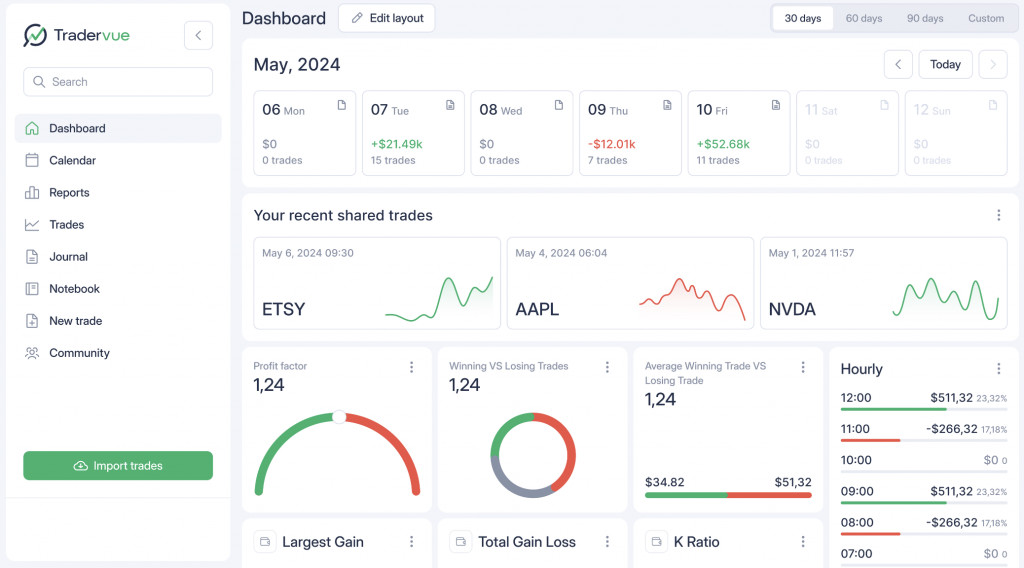
Tradervue lets you track, analyze, and improve your stock, futures, and forex trades
What Makes A Good Trading Journal?
A good trading journal is simple to use, captures the details that matter, and helps you learn from every trade. Here are the main features to look for:
Timeframe Tracking
Swing trading means you hold trades longer, sometimes a week or more. Your journal should make it easy to record longer timeframes.
What to check for:
- Can you note entry and exit dates without it feeling cramped?
- Can you see how the trade unfolded over several days?
- Does the journal allow you to attach charts from different timeframes?
Example: You open a swing trade on EUR/USD on Monday and close it on Friday. A good journal should allow you to log both dates, and also include a daily chart showing how the price moved in between.
Chart & Screenshot Storage
Swing traders rely heavily on chart setups. You need a way to save those setups when you enter a trade.
What to check for:
- Can you upload screenshots?
- Can you mark up charts or add notes?
- Can you look back and see ‘before and after’ images?
Example: You spot a bullish flag on Tesla. You take a screenshot before entering. A week later, the trade hits your target. You upload a second screenshot to compare. Seeing both side by side helps confirm if the setup worked as expected.
Risk & Position Size Tracking
Managing risk is just as important as finding good setups. Swing trades can last longer, so market swings can test your patience. A good journal helps you stick to your risk plan.
What to check for:
- Can you record your position size, stop-loss, and take-profit levels?
- Does it show risk-to-reward ratios?
- Does it track win rate and average return?
Example: You risk 1% of your account on each trade. The journal should allow you to log that and later calculate whether you stayed consistent or broke your own rules.
Notes & Emotions
Swing trades test emotions because you hold them for days. Fear can push you to close early, or greed can tempt you to hold too long. A journal gives you space to write what you feel.
What to check for:
- Is there room for free-form notes?
- Can you tag trades with emotions like ‘fear’ or ‘overconfidence’?
- Can you review these notes later in a simple way?
Example: You write: “Felt nervous holding through CPI report.” Later, you notice you always cut trades early before news—even when your setup is solid. That’s a pattern you wouldn’t catch without notes.
Recording my emotions in a journal turned out just as valuable as tracking price levels—seeing notes like “closed too early out of fear” or “held too long hoping for more” made the psychological patterns behind my trades impossible to ignore.
Review & Analytics
The point of a journal isn’t just logging trades—it’s learning from them. The review tools are where the value shows up.
What to check for:
- Can you sort trades by setup, ticker, or time held?
- Does it give win/loss breakdowns over weeks or months?
- Can you spot your most profitable setups?
Example: You filter your journal and see that your best results come from swing trades held 3–5 days. Anything longer often ends in small losses. That’s a clear insight you can use to refine your approach.
Keeping a swing trading journal taught me more about my habits than my charts did—I saw the wins, but more importantly, I spotted the times I broke my own rules.
Ease Of Use
The best journal is the one you actually use. If it takes too much time, you’ll stop filling it out.
What to check for:
- Is it quick to log a trade?
- Can you use it on both desktop and mobile?
- Does it feel natural for your style?
Example: Some traders prefer Excel because they can customize it to their specific needs. Others prefer ready-made apps because they’re faster. There’s no correct answer, only what you’ll actually stick with.
Cloud Vs Local
Where you store your journal matters. Cloud-based journals are easily accessible from anywhere. Local ones (like spreadsheets) give you more control.
What to check for:
- Do you need to access your journal on the go?
- Are you comfortable storing data online?
- Do you want full customization?
Example: If you frequently trade from multiple devices, a cloud journal might be a better option. If you only trade from one computer and want to design your own format, Excel or Google Sheets could be enough.
Cost
Some journals are free. Others come with a monthly fee. Cost doesn’t always mean better, but paid journals often include analytics and automation.
What to check for:
- Does the free version cover your needs?
- If it’s paid, are you using the features that justify the price?
- Would a simple spreadsheet suffice for now?
Example: A beginner might start with a free Google Sheet. Once you’ve built consistency and need more in-depth analytics, you might consider investing in a tool that saves time.
I started with a free spreadsheet, and it did the job, but once I paid for a proper journaling tool, the built-in analytics saved me hours—I realized the cost was small compared to the clarity it gave me.
Examples Of Journaling A Swing Trade
Let’s walk through a simple example.
- You spot a breakout setup on Apple at $170.
- You plan to risk $200 with a stop at $165.
- You enter on Monday.
- On Friday, the price hits $180.
In your journal, you log:
- Entry: $170 (Oct 2)
- Stop: $165
- Exit: $180 (Oct 6)
- Position size: 40 shares
- Risk: $200
- Reward: $400
- Setup: Breakout of resistance
- Notes: “Strong volume on breakout. Felt nervous after the second day pullback but held.”
Later, when you look back, you’ll see how your plan lined up with the result.
Building A Habit
A journal only works if you use it consistently. It doesn’t need to be perfect. Even simple notes are better than none.
Tips to build the habit:
- Log every trade the day you take it.
- Review once a week.
- Focus on learning, not just numbers.
Bottom Line
For swing trading, the best journal is one that makes it easy to track trades over days or weeks, add charts, and review your own behavior. Whether it’s a paid app or a simple spreadsheet, the key is using it consistently.
Your trading journal for swing trading is your feedback loop. It shows you what’s working and what’s not. If you take the time to maintain it, it will quietly shape you into a better trader.