
Best Copy Trading Brokers 2026



Copy trading lets you follow top traders and ride their momentum—perfect for swing traders who want flexibility without missing opportunities.
But not every broker is built for this – I know I’ve got plenty of experience copy trading. In this guide, we’ll highlight the best swing trading brokers for copy trading so you can trade smarter, not harder.
How SwingTrading.com Chose The Best Copy Trading Platforms
We investigated each copy trading service, evaluating factors like ease of use, available strategies, and performance tracking where possible.
Providers were then ranked by overall ratings, based on a wide range of factors relevant to swing traders, including fees, execution quality, and trader community features.
What Is Copy Trading?
Copy trading platforms work by connecting you with signal providers—typically experienced traders—whose strategies can be automatically mirrored in real time.
When a signal provider opens, modifies, or closes a trade on their account, the same action is replicated in your account, either proportionally (based on allocated capital) or on a fixed-lot basis.
The underlying technology is built on broker APIs or native platform integrations, which allow seamless execution across accounts without manual input from the follower.
This reduces the sensitivity to latency and slippage that can affect shorter-term strategies like scalping or high-frequency day trading.
It also gives you more time to review trades, understand the rationale, and make informed decisions about whether to continue copying a particular strategy.
Advanced platforms often include risk management tools such as maximum drawdown limits, equity stop-outs, and adjustable trade sizing.
Many also feature trader analytics dashboards, showing key swing trading metrics like average holding time, win/loss ratios, risk scores, and drawdown history.
What Assets Can Be Copy Traded?
Copy trading platforms offer access to a wide range of assets and markets, allowing you to replicate strategies across various instruments, including forex, stocks, indices, commodities, and cryptocurrencies.
The availability of these markets depends on the broker and platform you use. Still, most leading platforms support multi-asset trading, making it easy to diversify your portfolio while following traders with expertise in specific instruments.
Swing traders also favor equity markets (mainly US and European stocks) on copy platforms, where traders typically look to capitalize on earnings cycles, price breakouts, or mean-reversion patterns over days or weeks.
Proprietary platforms like eToro often feature stock-focused swing traders who blend technical and fundamental analysis for medium-term plays.
Indices (such as the S&P 500, Nasdaq, DAX) and commodities (like gold or oil) are also standard among swing traders on copy trading platforms, as these instruments exhibit strong trending behavior, making them ideal for multi-day strategies.
Cryptocurrencies, while more volatile, have gained traction on platforms that support 24/7 trading and offer swing-style strategies that exploit short-term momentum and retracement levels.
Copying across different asset classes also allows you to diversify risk and gain exposure to non-correlated markets, which is a significant advantage when applying swing strategies passively.
Proprietary vs Independent Copy Trading Platforms
Proprietary copy trading platforms are developed and operated directly by brokers themselves, creating an integrated ecosystem where trading, execution, and copy services coexist within a single environment.
Because the broker controls the entire infrastructure, these platforms often benefit from optimized trade execution speeds, seamless account management, and unified user interfaces.
This tight integration can reduce latency and slippage, critical factors for swing traders who rely on precise entry and exit points over multi-day horizons. Examples include platforms like eToro or NAGA, where social trading features are built into the broker’s native platform.
Platforms such as ZuluTrade, cTrader Copy, DupliTrade, and Signal Start act as intermediaries, offering a marketplace of signal providers that you can follow regardless of which broker you use (provided the broker supports the platform).
This independence allows for greater diversity of trading styles and providers, but can introduce execution complexity—orders must be routed through multiple systems, which may increase latency or slippage risks.
However, these platforms often offer advanced analytics, customizable risk settings, and sophisticated filtering tools that appeal if you want granular control over your copy trading strategies.
For swing traders, the choice between proprietary and independent platforms depends on priorities. Proprietary platforms offer streamlined, often faster execution with fewer compatibility issues.
In contrast, independent platforms provide access to a broader pool of traders and more customizable risk management, albeit sometimes with trade execution trade-offs.
Understanding these differences will help you select the best infrastructure for replicating medium-term swing strategies effectively.
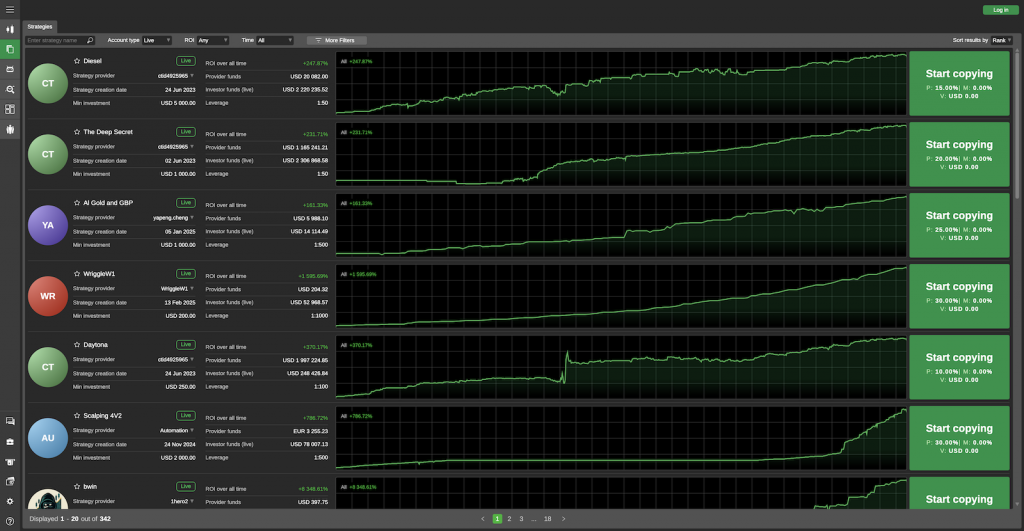
cTrader Copy lets you filter strategies by ROI, but it doesn’t offer a risk score
What To Look For In A Copy Trading Provider
Choosing the right broker is essential for successful swing copy trading, as it directly affects trade execution, platform reliability, and access to quality signal providers.
Here are the main features to look for when evaluating a broker for swing-focused copy trading.
Platform & Tools
A high-quality platform doesn’t just replicate trades—it provides a robust infrastructure for discovering, analyzing, and managing strategy providers.
This includes a well-designed marketplace with a diverse selection of traders, detailed performance metrics, and transparent trading histories.
Without these elements, you are left guessing about a provider’s actual skill, risk profile, or consistency, which undermines the core value of copy trading.
Equally important is the platform’s filtering and ranking system. Sophisticated platforms allow you to search for swing traders based on specific criteria: average trade duration, drawdown limits, risk score, win rate, asset class focus, and even trade frequency.
For swing trading, where holding times and timing precision matter, being able to filter out short-term scalpers or high-risk traders is critical. Platforms that lack these filters often lead users to copy based on vanity metrics like short-term ROI, which can be misleading or unsustainable.
Transparency is another key factor. The best copy trading platforms offer complete visibility into a trader’s open and closed positions, historical trade logs, and even real-time updates on new trades.
This allows you to assess not just performance, but also how well a trader executes their strategy under different market conditions. When platforms hide or obscure this data, it becomes difficult to evaluate whether a swing trading approach is being followed consistently.
Ultimately, a high-quality platform empowers you with the tools, data, and controls needed to make informed, risk-aware decisions, turning copy trading from a passive shortcut into a strategic investment method.
Depth & Diversity
The depth and diversity of strategies on a copy trading platform directly impact your ability to build a well-rounded and resilient portfolio. A deep marketplace means you’re not limited to a handful of generic strategies.
Instead, you can choose from a range of well-defined trading styles, including trend-following, mean reversion, breakout trading, or volatility-based swing setups.
This allows you to align your capital with traders whose methodologies match your risk tolerance, time horizon, and asset preferences.
Diversity also reduces concentration risk. By following traders who specialize in different markets—such as forex, equities, crypto, or indices —and who use distinct approaches, you avoid being overexposed to a single market condition or asset class.
For swing trading, this is especially important as some strategies thrive in trending markets, while others are optimized for sideways or choppy conditions.
A platform that offers multiple swing-focused traders with varied holding periods, asset coverage, and risk profiles allows you to adapt to changing market environments without constantly switching providers.
In technical terms, depth and diversity enhance your ability to construct a copy trading portfolio with non-correlated strategies, much like traditional asset diversification.
Platforms that offer granular filtering—such as by average holding time, risk score, maximum drawdown, or trade frequency—make it easier to identify and combine these strategies intelligently.
Without this variety, you’re placing all your trust in one trader’s approach, which increases volatility and reduces long-term stability.
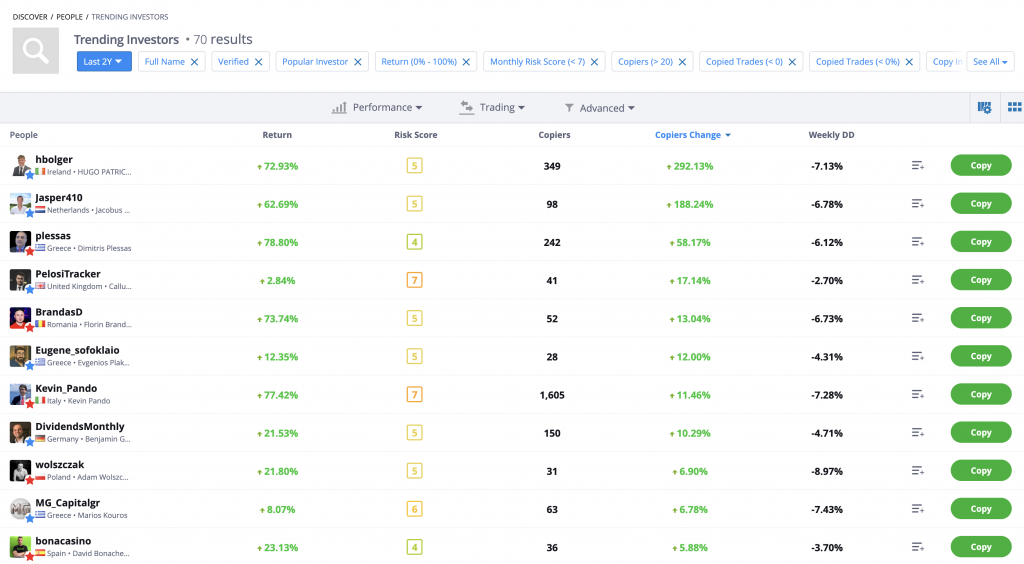
eToro offers advanced filters to find strategy providers that fit your trading style
Pricing & Commissions
Pricing and commissions on a copy trading platform are more than just a line item—they directly impact your net returns. They can erode profits over time, especially with swing trading strategies that may hold positions for days or weeks.
Unlike high-frequency trading, where tight spreads are critical, swing traders focus on capturing larger price moves.
However, accumulated costs like copy fees, spreads, overnight financing (swap) charges, and platform commissions can still significantly affect outcomes when compounded over many trades.
Performance fees can align incentives between signal providers and followers, but only if they’re charged on a ‘high-water mark’ basis— meaning the trader must exceed previous profit peaks before earning more fees.
Without this, you risk paying fees on temporary gains, even if long-term returns are flat or negative.
Platforms with transparent pricing structures and detailed cost breakdowns help you assess whether you’re paying fairly for performance.
Understanding the complete cost model—not just headline fees—is essential for selecting a copy trading platform that supports long-term, sustainable swing trading.
Risk-Free Demo Mode
A risk-free demo mode on a copy trading platform lets both beginners and experienced traders evaluate performance, functionality, and risk without committing real capital.
This provides a realistic sense of how the platform executes trades, how slippage or delays may occur, and how swing strategies play out over multiple days, all without financial exposure.
For swing trading, demo environments are especially valuable because trades typically unfold over longer timeframes. This gives you time to assess not just performance, but also how a strategy provider handles entries, exits, and risk management over days or weeks.
It also helps you identify whether a provider’s strategy aligns with your expectations and whether your risk appetite matches the volatility and drawdown profile of the strategy being copied.
Technically, a good demo mode should offer full access to real-time data, performance tracking tools, and platform features, including position sizing controls, stop-loss settings, and portfolio analytics.
A robust, risk-free demo mode helps you validate the reliability of the platform, fine-tune your settings, and gain confidence before moving into live copy trading.
I regularly use demo accounts on cTrader Copy to test strategies before committing real funds. It’s a habit that’s saved me more than once—many providers chase unrealistic ROI targets and end up blowing their accounts.Demo copying helps me spot red flags early and stick with strategies that show consistent, sustainable performance.
Regulatory Oversight
Regulatory oversight is a significant factor when choosing a copy trading platform because it directly affects the safety of your funds, the transparency of operations, and the platform’s legal accountability.
Regulated platforms must comply with strict rules on client fund segregation, anti-money laundering (AML), and know-your-customer (KYC) procedures. This reduces the risk of fraud and ensures that brokers maintain sufficient capital reserves to protect users in adverse conditions.
For swing traders, who often hold positions over multiple days, this layer of protection is vital to avoid unexpected disruptions or fund freezes.
For example, from January 2022, NAGA no longer accepts clients from the UK and several other regions due to changing regulatory landscapes, such as FCA guidelines. Additionally, ZuluTrade’s NFA membership was terminated as of July 14, 2016, which means that US residents are unable to access the platform.
This demonstrates how regulation can impact not only safety but also accessibility. You need to ensure the platform you choose is fully authorized to operate in your jurisdiction, as trading on unregulated or unauthorized platforms may expose you to legal risks and limited recourse in case of disputes.
Moreover, regulatory supervision often enforces transparency in pricing, execution, and risk disclosures. Platforms under regulatory scrutiny must provide clear information about fees, execution quality, and the risks involved in copy trading.
This transparency helps you make informed decisions, manage expectations, and avoid hidden costs that can erode profits.
I used to follow a few successful swing trading strategies on NAGA and had a good experience with its copy trading features. That changed when it announced it would no longer support UK users. I was notified by email and had about a month to withdraw my funds.The process was smooth, but it highlighted how crucial regulation and platform access are when choosing a broker.
Bottom Line
The best swing trading brokers for copy trading combine reliable trade execution, user-friendly platforms, and access to a diverse pool of skilled swing traders.
They offer transparent fee structures, robust risk management tools, and strong regulatory oversight to protect investors.
These brokers enable you to easily follow proven strategies, making swing trading accessible and efficient for both beginners and experienced investors.
FAQ
Can I Make Money With Swing Copy Trading?
Yes, you can make money with swing copy trading by replicating the trades of skilled swing traders who capitalize on medium-term market moves.
However, success depends on choosing reliable traders, managing risk carefully, and understanding that returns aren’t guaranteed—losses are always possible.
It’s a way to generate profits with less hands-on effort, potentially, but it requires due diligence and patience.