
Best Forex Signals For Swing Trading 2026



Many traders utilize forex signals to aid in determining when to enter or exit a trade. But not all signals are helpful, and not all match the swing trading style.
After extensive testing by our seasoned swing traders, we highlight the key things to check before you rely on forex signals for swing trading.
Understand What A Swing Trading Signal Is
A swing trading forex signal is a trade idea based on technical or fundamental analysis. It usually includes:
- Entry price (where to open the trade).
- Stop loss (where to cut the trade if it goes wrong).
- Take profit (target price to close the trade in profit).
- Timeframe (how long the signal is expected to play out).
For swing trading, the timeframe matters. You want signals that last days, not minutes. A signal that expires in 15 minutes is not swing trading.
Example:
A swing trading signal might look like this:
- Pair: EUR/USD
- Buy at 1.0500
- Stop loss at 1.0400
- Take profit at 1.0700
- Expected holding time: 3–7 days
This is very different from a scalping signal, which says, ‘Buy EUR/USD now at 1.0500, close in 5 minutes.’
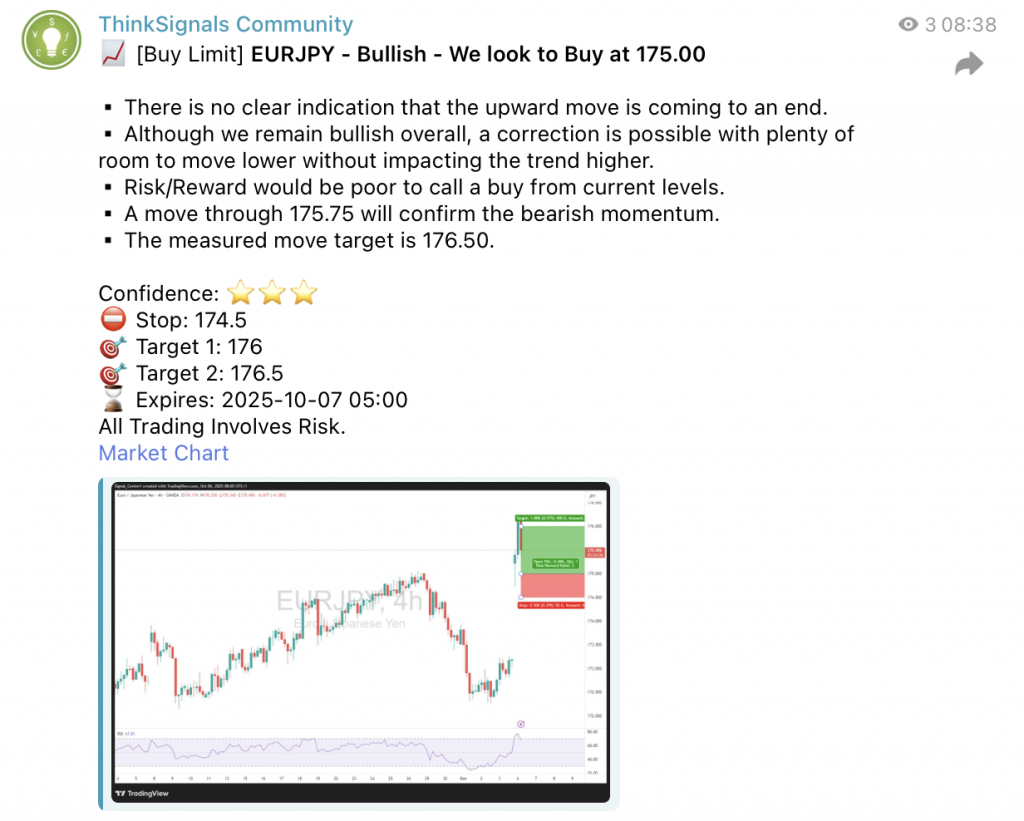
ThinkMarkets provides detailed signals from FCA-regulated Signal Centre
Types Of Forex Swing Trading Signals
Forex Swing Trading Signals aren’t the same at every provider. Here are the main things to keep in mind:
Timeframe Alignment
Swing trading is most effective on 4-hour and daily charts. Signals designed for those charts give more stable moves. If a provider mostly sends signals on 5-minute charts, that’s not swing trading.
Risk Management In The Signal
A good swing trading signal always shows a stop loss. If it doesn’t, that’s a warning sign. Swing trades can last for days, so the price may move against you before it goes your way. You need to know the maximum loss upfront.
Also, check the risk-to-reward ratio. Many swing signals aim for at least 1:2. That means risking 100 pips to make 200 pips.
Example:
- Buy GBP/JPY at 180.00
- Stop loss: 179.00 (risk 100 pips)
- Take profit: 182.00 (gain 200 pips)
Frequency Of Signals
Swing trading doesn’t need dozens of signals each day. If you get that many, they’re probably scalping calls. Swing signals are slower. You might see 2–5 solid setups per week on major currency pairs.
Entry & Exit Clarity
Signals should clearly indicate where to enter and exit. Vague instructions like ‘buy EUR/USD soon’ are not helpful. You need numbers you can set in your platform and walk away.
Type Of Analysis Behind The Signal
Swing trading often employs technical analysis, including trend lines, support and resistance, and moving averages. Some providers also factor in fundamentals like interest rate news.
As a beginner, you don’t need deep economics. But it helps to know why a trade is suggested. Even a brief explanation, such as ‘buying because price bounced from daily support,’ is better than no reason at all.
Holding Through Swings
A common mistake is closing trades too soon. Swing trades often dip into small losses before heading toward profit. A good signal should be built with that in mind.
For example, a signal might buy EUR/USD at 1.0500 with a stop at 1.0400. If price drops to 1.0480 first, that’s still within plan. Panic closing at 1.0480 means you cut the trade before it had time to work.
Swing trading requires patience. Ensure the signals you follow are designed with sufficient room for prices to move.
I’ve found that swing trading signals are helpful, but they’re not perfect. Some work well, others don’t, and that’s just part of trading. What helped me most was using them as a guide while I learned to be patient and let trades run for days without second-guessing every small move.
Matching Signals To Your Account Size
Not every trader can take the same signal. If a provider risks 300 pips per trade, small accounts may not be able to handle that. For swing trading, the pip distance is often larger than for day trading.
You need to size your positions correctly.
Example:
- Signal: Buy EUR/USD at 1.0500, stop at 1.0400 (risk 100 pips).
- If you trade 0.1 lot, 100 pips = $100 risk.
- If that’s too big for your account, reduce the size to 0.01 lot ($10 risk).
The signal is the same, but you adapt it to your account.
Track Record & Transparency
While you don’t want marketing promises, you do need some record of past trades. Even a simple list of wins and losses can be helpful. No provider wins 100%. Losses are part of swing trading.
Independence Vs Blind Copying
Signals can guide you, but don’t depend on them forever. Use them as training wheels. Look at the charts yourself, compare the trade idea, and ask why it makes sense.
Over time, you’ll start spotting your own setups. That’s when you gain confidence and don’t need signals for every move.
Example Of A Forex Swing Trading Signal In Action
Here’s a simple walk-through:
- Signal: Buy AUD/USD at 0.6500.
- Stop loss: 0.6400.
- Take profit: 0.6700.
- Holding time: 5 days.
Day 1: The price reaches 0.6480. Small drawdown, still above stop loss.
Day 2: Price climbs to 0.6550. Trade is slightly positive.
Day 3: Price dips again to 0.6490, testing patience.
Day 4: Price rises strongly to 0.6620. Now deep in profit.
Day 5: Price hits 0.6700. Take profit triggered. Trade closed.
This is typical swing behavior. It moves back and forth before reaching the target. The signal gave enough space to survive the dips.
Final Thoughts
The best swing trading forex signals can help beginners, but only if they align with the trader’s style.
Look for signals with clear entry, stop, and target. Ensure they use the right timeframes, have a reasonable risk-to-reward ratio, and refrain from overwhelming you with excessive noise.
Most of all, remember that no signal is magic. They’re just trade ideas. It’s up to you to manage risk, size your trades, and stay patient.